Showing posts with label Martha Longhurst. Show all posts

Wednesday, 26 May 2010

The Death Of Martha Longhurst

Regular readers of this blog will know that my favourite Coronation Street era is the 1960s. Many modern day Street fans can't understand this, some declare that the crackling old black and white episodes and occasional rough edges are interesting, even enjoyable, but find it hard to cope with the sometimes naff sound quality and the fact it was in black and white until 1969.

"Black and white? Well really!! How... how... archaic..."

Others feel, as I do, that the Street lost some of its grittiness when it went into colour, and that the golden era was definitely, beyond any shadow of a doubt, its first decade.

Watching Ena Sharples (Violet Carson) confronting Elsie Tanner (Pat Phoenix) in the street whilst the Salvation Army band played, Mr Swindley (Arthur Lowe) and Miss Nugent (Eileen Derbyshire) struggling along at Gamma Garments, or Valerie Barlow (Anne Reid) being confronted by an escaped convict in her own home, absorbs me far more than anything that came later.

And yet I'm too young to actually remember the '60s era in the show!

Thank goodness for VCRs (the Street's very first video release, which contained early 1960s episodes, dates back to 1982) and DVDs, which have both given us wonderful opportunities to witness the Street as it was in the black and white days. Thanks also to the three Coronation Street novels written by HV Kershaw in the 1970s - all set in the 1960s, which, along with a special clips episode of the show, featuring Annie Walker (Doris Speed) and Betty Turpin (Betty Driver) reminiscing, first aroused my interest in the mighty first decade.

The '60s had great comedy (contrary to Wikipedian myth, the Ogdens had wonderful comic story-lines from their very early days onwards), and brilliant drama. The acting was usually top-notch and still makes a tremendous impact on viewing the episodes all these years later.

Wondrous days.

A grotty backstreet with a nice publican and his snobbish wife, a grumpy old First World War veteran, a cheeky scouse rascal with a flat cap, a pompous lay preacher, a gossipy little shrew in curlers, and a dress shop employee who was "no better than she ought to be"!

What a setting! As Mary Malone of the Daily Mirror once wrote:

The Street is either a place you would like to live in or be glad you got out of. It is intimate, nosey, brutally sharp-spoken, and no-one gets away with a thing.

And in the middle of all the action, often desperately craning their necks to find out the exact details, sat three old ladies in the Snug of The Rovers Return - one, the leader, a hair-netted battle axe, one a cat-loving whimsical sweety, and the third a vinegary feeder on the misfortunes of others.

The three old ladies were, of course, the aforementioned Ena Sharples, Minnie Caldwell (Margot Bryant) and Martha Longhurst (Lynne Carol).

They provided the Street with some of its funniest scenes ever, and were a tremendously popular ingredient in the show's already rich brew.

They reigned supreme from 1960 to 1964.

Illustration from a Coronation Street jigsaw puzzle - c. 1963: the scene is Rosamund Street. Gamma Garments can be seen in the background (was Mr Papagopolous visiting that day, we wonder?!) and outside Minnie Caldwell helps her beloved Bobby across the road, with Albert Tatlock officiating as lollipop man. Martha Longhurst and Ena Sharples look on.

Eee, the old Snug days...

Gossip and milk stout. Fierce arguments and milk stout. Ramblings about Bobby the cat and milk stout.

It was bliss.

And then, in May 1964, Martha Longhurst died of a heart attack all alone at the table the three ladies usually shared in the Snug bar.

An absolutely stunning tragedy for the show and its viewers.

And with the actress Lynne Carol, who played Martha, in good health and happy to continue in the role at the time, it's a puzzle to work out why it happened.

What was going on?

During the reign of producer Tim Aspinall, a decision was taken to shake-up the show. Coronation Street had taken a slight tumble in the ratings, and several established characters, including Florrie Lindley (Betty Alberge), Frank Barlow (Frank Pemberton) and Concepta and Harry Hewitt (Doreen Keogh and Ivan Beavis) were to be written out.

And Martha.

Some who faced the axe - including Albert Tatlock (Jack Howarth) and Ken Barlow (William Roache) - were reprieved, but Martha was not so lucky.

Lynne Carol came from a family containing six generations of actors. She was born in Usk, Monmonthshire, where her parents were on tour in a stage play.

Miss Carol auditioned for the role of outgoing Corner Shop keeper Elsie Lappin in November 1960. She didn't get it, but instead was awarded a week's work as a temporary character called Martha Longhurst.

Upon leaving the Granada TV studios after completing her week's stint, Lynne Carol was stopped by Margot Bryant, who remarked that Martha had a lot to say in next week's scripts.

This came as news to Miss Carol, who was not even aware that Martha was in the following week's episodes!

Had the part been recast? She returned to her dressing room to find the script for the following week awaiting her.

Martha was vinegary and not the kindest of souls. But she was also quite a sad character. She doted on her daughter Lily and Lily's husband Wilf, and boasted of their achievements to her friends, but truth to tell Lily and Wilf simply saw Martha as a free babysitter - when they saw her at all.

One had the feeling that, given a bit of care and attention, Martha might have been very different.

But it was not forthcoming.

And so there she was, taking on a cleaning job at The Rovers to eke out her meagre pension, and living alone in misery at Mawdsley Street.

Martha: "You know, the more I think about the way Ena's behaving, the madder I get. I wouldn't care, but I know for a fact that in her own mind she thinks she's beautiful."

Lynne Carol said of her character: "She is such a pathetic old thing, you can't help feeling sorry for her. She is crusty and very disappointed with life. She has a daughter she idolises, but who is clearly not interested in her. But underneath, Martha is quite a sweet old soul, though the sweetness doesn't get much chance to come out."

In early 1964, the Corrie cast read newspapers rumours of cast changes to come, but were told by Granada to ignore them.

Lynne Carol recalled a few years later:

"At one time there were about ten of us supposed to be due for the axe. We read rumours about it in some of the newspapers, but we were told by Granada not to take any notice of the Press because they didn't know what they were talking about. But it turned out the Press were right. The artists themselves knew nothing about it until quite suddenly one day when a number of us were told, 'You, you, you and you... are all going out!' "

Violet Carson protested strongly to Granada against Martha's proposed demise: "You cannot take one of Ena's cronies away from her. Martha is essential to Ena."

In the story-line, Martha's death tied-in with the farewell story-line of another of the Street's original characters: Frank Barlow had come up on the Premium Bonds and was celebrating his good fortune and planned move to Bramhall with a party at The Rovers.

Martha had gone along to the party, clutching her brand new passport. Lily and Wilf had invited her to go with them and their kids on holiday to Spain.

It was a moment of glory for poor Martha, despite Ena's taunts that she was only wanted as a babysitter and wouldn't be seeing much of Spain outside of the hotel room.

At Frank's party, nobody seemed that interested in Martha's passport.

And she didn't feel well.

No, she didn't feel well at all.

As Ena led the regulars in a sing song round piano, Martha retreated to the Snug and sat down at the old familiar table.

Eileen Derbyshire, the Street's Emily Nugent/Bishop, recalled many years later:

"Even at the filming, everybody was having that outside hope that there would be a reprieve for Lynne Carol the actress and Martha the character. There was this terrible double bind of having to be singing and laughing whilst your throat was being constricted by the tears. It was a really horrible emotional experience."

Despite the hopes still flickering at that late point, there was to be no reprieve.

In the little Snug bar, Martha was overcome by a heart attack. Knocking her best hat from her head, revealing her hair net, she slumped down on to the table, all her dignity gone.

And her life.

Peter Adamson, the Street's Len Fairclough, bet five pounds that Granada would not go through with Martha's death story-line. It was Len who pronounced Martha dead in the Snug at The Rovers, and he deliberately paused before delivering the fatal line, so that it could be cut and Martha rushed to recovery in hospital.

Said Lynne Carol a few years later:

"It seemed like an eternity waiting for Peter to say that last, awful line. I can remember lying there thinking, 'Well, say something, mate, if it's only goodbye!' "

The episode complete and in a state of some distress, Lynne Carol joined her husband, the actor Bert Palmer, who was also working at Granada at that point. He retrieved Martha's hat and glasses from the Coronation Street set (they belonged to Lynne) and made a cine film of Martha's death from the television screen the night the episode was broadcast, 13 May, 1964.

Miss Carol said of Martha's death and funeral episodes: "It's a funny thing to watch yourself dying on the screen. I don't think the death was morbid, but the way they did the funeral was outrageously morbid. They took the body through all the rubble of the back streets. It was depressing."

Interviewed about her ousting from the Street later in the 1960s, Lynne Carol said:

"I didn't blame Tim [Aspinall] particularly. Everyone passed the buck. Nobody would really admit who was responsible for the sweeping changes they made in 1964. It was, as far as I'm concerned, Mr Nobody who ordered the big reshuffle."

In 1981, HV Kershaw's book, The Street Where I Live, stated that the decision had been Mr Aspinall's, and Mr Kershaw lamented the decision, pointing out that the famous trio had been reduced to "a rather sad duet" because of it - and that many future stories had been denied the writers. But, balancing out this negative aspect of Mr Aspinall's reign, Mr Kershaw also pointed out that Stan, Hilda and Irma Ogden - "the best dramatic inventions since the original characters were conceived by Tony Warren" - had been introduced during that time. And Mr Aspinall had been largely responsible for their casting and characterisations.

Corrie Producer Bill Podmore appeared with Lynne Carol on the BBC's Open Air programme in 1988, to pay tribute to the recently deceased Margot Bryant. Ironically, Miss Carol could still have been appearing in the Street as Martha at that point, preserving a link to the original trio of the early years.

Mr Podmore and Miss Carol discussed the idea of her reappearing in the show as Martha's twin sister, who had been living in Australia. The idea never came to fruition.

For many years, the killing of Martha has been seen by many as the greatest mistake ever made in Corrie's history.

And watching Ena Sharples and Minnie Caldwell together in the Rovers in later years, it was evident that something rather wonderful had been lost. They really were, as HV Kershaw stated, "a sad duet".

On one occasion, in the early 1970s, Ena asked Minnie if she was looking after herself. Minnie assured her that she was.

"Good!" replied Ena. "Because there aren't that many of us left!"

After leaving the Street, Lynne Carol bought a house near Blackpool's South Shore.

She named it "Longhurst".

This blog post is dedicated to the memory of Lynne Carol, 1914-1990.

Thursday, 21 January 2010

Said In The '60s - Part 1

Minnie Caldwell (Margot Bryant) and Martha Longhurst (Lynne Carol) in the Snug at The Rovers:

Martha: "You know, the more I think about the way Ena's behaving, the madder I get. I wouldn't care, but I know for a fact that in her own mind she thinks she's beautiful."

Minnie: "Oh, I wouldn't say beautiful, but she is a bonny woman."

Martha: "BONNY?! Ena Sharples' face is so ugly it wouldn't make ear 'oles! I've only met one woman plainer and that's our Jessie."

Minnie: "Oh, but your Jessie can't 'elp it. Well, I mean, it isn't many women as falls through a garage roof..."

Monday, 2 March 2009

Minnie Caldwell And Her Bobby

Was there ever such a sweet and gentle soul as Minnie Caldwell, who moved into No 5 Coronation Street from nearby Jubilee Terrace in 1962? Already well known in the Street as a Rovers regular, the widow Caldwell had cared for her invalid mother for years, and was a long-time friend to Ena Sharples, who lived in the vestry at the Glad Tidings Mission Hall, and Martha Longhurst of Mawdsley Street.

The three old ladies were, on most days, to be found in their second home, the Snug bar at the Rovers, drinking milk stout, keeping an eye on their neighbours, and gossiping. Well, that is to say, Ena and Martha gossiped - Minnie would usually sit there, smiling obliviously, and chipping in with occasional, often inappropriate, comments. A bit "away with the fairies" was our Minnie.

Whereas Ena and Martha's views on life and human nature were pickled in vinegar, Minnie beamed sweetly on all and sundry, seeing life as something rather lovely.

Margot Bryant, the actress behind Minnie Caldwell, was a member of the original Coronation Street cast, and made her on-screen debut in episode two.

Jean Alexander (Hilda Ogden) recalled how the character of Minnie originated and developed in her 1989 autobiography, The Other Side Of The Street:

Her introduction to Coronation Street was as an extra - an old lady who never said a word but submitted to Ena Sharples's withering comments on her intelligence. Then she was occasionally given the odd line which, in her inimitable way, she made funny; and so Minnie Caldwell became the character who earned so much sympathy from the viewers. What they did not know was Margot's ability to forget key words in her dialogue and substitute others that frequently made no sense. "My father had a dog once," she said. "It was a ferret..."

In the story, Minnie had always loved cats and the wedding present from her husband, Armistead, was a small, tabby kitten. Minnie and Armistead were not blessed with children, much as they would have liked them, and so the Caldwell household always included a cat for Minnie to dote on.

When she moved into Coronation Street, she brought with her a large ginger tom called Bobby. As Street producer and writer Harry Kershaw observed in his 1977 Corrie novel, Early Days, Minnie would have "cheerfully died before inflicting the slightest pain on Bobby"!

Bobby first appeared in The Street in 1962, and was originally to be called "Skippy", but Margot changed the name to Bobby. The original Bobby (left) was actually called Toby!

Toby died in 1968, and Margot Bryant was deeply upset. In the story-line, Minnie's Bobby disappeared. She thought she spotted him up on the viaduct and Stan Ogden rescued him, getting scratched in the process. Sadly the viaduct moggy was not Bobby. However, the cat was a stray and Minnie adopted him, calling him "Sonny Jim" (or "Sunny Jim", if you prefer!), which had been her affectionate nickname for her lodger, Jed Stone.

In 1969, with a little nudge from Ena Sharples, Minnie renamed the viaduct stray "Bobby".

The new Bobby did not endear himself to Albert Tatlock when he ate Albert's pigeon, Gilbert, in 1975!

Unlike Minnie, Margot Bryant never married, but, just like Minnie, she absolutely adored cats. When Eileen Derbyshire (Emily Nugent/Bishop) brought her new baby into the studios, Margot commented: "What a pity it isn't a kitten!" She took cat food out to feed the hungry strays of Venice, and grandly dubbed her own large ginger tom "The Earl of Hammersmith". She adored him so much, she gave him a life peerage, and was devastated when he died at the age of eleven.

"Of course cats understand me," she once said. "Cats are super-intelligent animals. It depends on how you treat them. If you never spoke to a child, it would never learn anything. It's just the same with cats. If you speak to them all their lives, then they understand you."

Oh dear - Minnie's in trouble! Another happy evening in the Snug at The Rovers with Ena and Martha. Ena (Violet Carson) ruled the roost, Martha (Lynne Carol) constantly sought to usurp her, but never succeeded, and Minnie, at first glance, seemed the helpless focus of barbed comments from her two "friends". But the situation, according to Harry Kershaw, was a little more complex than that. He once wrote that Minnie saved her biting wit for appropriate moments, and then her barbed comments had an edge that even Ena envied!

But despite this, a worrying weakness for gambling, and a prominent stubborn streak, Minnie was mainly sweet, meek and mild. However, Margot Bryant was exactly the opposite. "I'm tough. Very tough," she once said. Miss Bryant was well known for her tendency to prove this statement, and for her usage of what Corrie Producer Bill Podmore called "barrack room expletives". Ken Irwin in his 1970 book The Real Coronation Street, entitled his chapter on Margot Bryant The Pussy-Cat Lady... With Fangs Of Her Own.

Many are the stories detailing Margot's "tough" side and I must say when I first read of it, I was stunned. Her playing of Minnie Caldwell was so effective, the character's air of simplicity and meekness flowing out of the TV screen so strong, that I found it hard to believe Miss Bryant's own character was so different.

I can only put it down to superb acting!

Born in Hull, doctor's daughter Margot followed her sister onto the stage. During her years as Minnie Caldwell, she bought a flat in Brighton (or Hove, according to one source), rented another in the Hammersmith district of London, and displayed a strong spirit of adventure - travelling all over the world. Her love of travel came about during her time as an entertainer with ENSA during World War II. Of the Coronation Street cast, she was probably most friendly with Jean Alexander - who shared her love of cats!

Back to the on-screen story: Jed Stone was a cheeky Scouse lad, out to make a bit of brass, and not too choosy about how he went about it. Of course, he had a heart of gold and was devoted to Minnie. He called her "Ma", she called him "Sonny Jim", and he moved into No 5 as a sort of lodger/substitute son figure.

Minnie was heartbroken when he went to prison for receiving stolen blankets in 1966.

Kenneth Cope, who played Jed, presented the Margot Bryant tribute programme Remembering Minnie Caldwell, after her death in 1988. In the 1990s, he said: "I think Margot liked Jed because it gave her a good story-line. If she had a lodger she suddenly wasn't one of a trio, she had a background which was not necessarily involved with the three of them in the Snug. I found playing with her smashing because I could rabbit on quickly and she'd bring me back with the slowness of it all."

Eek!! December 1970, and Minnie and Bobby were held hostage by American serviceman Joe Donnelli (Shane Rimmer). Joe had murdered Steve Tanner in 1968. Lodging with Minnie in 1970, he pulled out a gun and confessed. It was a messy affair - far different from the usual evenings at No 5, with Bobby lazing by the fire whilst Minnie told him the day's events. Stan Ogden became involved and, finally, Joe turned the gun and shot himself.

April 1976, and Rita Littlewood (Barbara Mullaney) had a bit of a gob on her because of yet another hitch in her stormy love life. Because of this, she was uncharacteristically hard-hearted when Minnie dithered over choosing an Easter egg for a friend's great-niece. Rita told her, quite forcefully, that she really hadn't the time to stand there whilst Minnie agonised over two eggs which were basically the same.

The Kabin scene occurred in Margot's penultimate Corrie episode, broadcast in April 1976, and was, I believe, the very last time Minnie was bullied in Weatherfield!

Minnie was absent for some months, and the story was spun that she was away staying with an old friend called Handel Gartside (Harry Markham), who had appeared in the show some years before. In October '76, Handel turned up in the Street to tell Ena that Minnie was staying with him. The reason for Minnie's non-return to say her farewells was, apparently, that she wanted to give Ena no chance to persuade her to stay at No 5.

The real-life reason behind Minnie's absence from her own on-screen farewell was that Margot Bryant had been in increasingly poor health for some years and was having great difficulty in remembering her lines. Street Producer Bill Podmore wrote in his autobiography, Coronation Street - The Inside Story (1990), about Margot's return to The Street after a period of illness:

Margot came back for a while, but it became increasingly difficult for her to memorise her lines. She began cutting them from the script and sticking them to the back of her handbag. But when it became obvious to everyone that she was reading during a recording, it had sadly reached the stage where it would have been unfair to ask her to carry on a moment longer. She wasn't at all well. There were more periods of illness, until finally we found her a place in a beautiful Cheshire nursing home where she spent the remainder of her days happily and in comfort.

Back to Minnie's final departure in the story-line of 1976, and Handel Gartside told Ena that Minnie would like her to have some item of her personal paraphernalia as a keepsake. Ena selected a picture of a cat (of course!) which had hung in Minnie's living room for many years - one of several!

"Take care of her for me..." - Ena, speaking to Handel Gartside.

Despite her bullying ways, particularly in the Street's early years, Ena cared a great deal for Minnie. And Minnie had said, back in 1969: "I wouldn't like to live to be a hundred. Ena mightn't be alive. And I wouldn't want to be alive if Ena wasn't alive."

The two women had been friends for many years and, when times were hard or personal problems pressing, had always been there for each other.

Ena closes Minnie's door for the last time. When she next visits the house, it will belong to a brash London businessman called Michael Vernon Baldwin.

Things certainly changed, as Mike's brief time at the house - shared out of wedlock with Rovers barmaid Bet Lynch - was followed by the Langtons' - Ray, Deirdre and baby Tracy's - brief "happy families" era (before Deirdre was attacked under the viaduct and Ray had an affair), then by the turbulent Tilsleys.

Minnie - and, of course, her Bobby - faded into Street history. And, in today's Coronation Street of explosions and serial killers, a very distant piece of Street history they seem!

This blog post is dedicated to the memory of Margot Bryant - 1897-1988.

Friday, 23 January 2009

1962: IIUIIIILY & IAIIILPS Superior Reading Biscuits - Get 'Em At The Corner Shop!

It's 1962, and Martha Longhurst (Lynne Carol), Minnie Caldwell (Margot Bryant) and Florrie Lindley (Betty Alberge) are horrified to see Christine Hardman (Christine Hargreaves) up on the raincoat factory roof, contemplating suicide.

In their angst, nobody seems to have noticed that Mrs Lindley is selling "IIUIIIILY & IAIIILPS [how on earth did you pronounce it?!!] Superior Reading Biscuits" at the Corner Shop.

Brand names were a problem for the Coronation Street production team for years, as it was assumed that the merest glimpse of a known brand name would be unpaid advertising - and send we viewers scrurrying out in our thousands to buy the product. So, the names would be heavily disguised (did IUIIIILY & IAIIILPS start out as Huntley and Palmer's, I wonder?) and you could end up with pure gobbledygook. It was better to stick a "Starmark", "Key" or "Fantasy" label over the offending trade name, as was often the case later.

However, there could be slip-ups. In Mrs Lindley's window can also be seen the highly distinctive Kellogg's brand name, looking slightly blurred but still recognisable!

Dependable Maggie Clegg (Irene Sutcliffe) appears to have scratched most of the Kellogg's name off of this box of Rice Krispies in the 1970s! "Really, Mrs Clegg, one feels one must protest at the dire state of your merchandise! If the box is in that state, what on earth must the contents be like?!"

HV Kershaw, Corrie writer and producer, recalled in his fascinating 1981 memoir, The Street Where I Live, that one incumbent at the Corner Shop caused the production team a severe headache. A recognisable tinned brand name was tucked away behind some dummy "Key" brand tins on the Corner Shop shelf. Unfortunately, the shop owner accidentally fumbled behind the dummy tins and produced one of the recognisable brand variety, telling her customer that she knew it wasn't as good as her usual brand, but it was all she had in stock at the moment! The manufacturer was quick to pick up the phone and dial Granada!

Mind you, that wouldn't go down too well in the current day and age!

Sunday, 9 November 2008

Rosamund Street, 1963

A beautifully detailed Coronation Street jigsaw puzzle design from c. 1963. Ena Sharples and Martha Longhurst are standing on the corner of Bessie Street, observing Minnie Caldwell escorting a local moggy (possibly Bobby!) across the busy main road - with the aid of Albert Tatlock, lollipop man.

Florrie Lindley is also an onlooker. Gamma Garments, workplace of Mr Swindley, Miss Nugent and Doreen Lostock, ruled by the unseen but terrifying Mr Papagopolous, can be seen in the background. "VOTE FOR SWINDLEY!" proclaims a poster on the side of the building - recalling Mr Swindley's foray into local politics as the leader of the Property Owners And Small Traders Party. Beside Gamma is a tobacco kiosk, and beside that a laundrette. The bus, a No 63, is heading for Victoria Street, Coronation Street, Rosamund Street and the Town Centre.

Piecing It All Together...

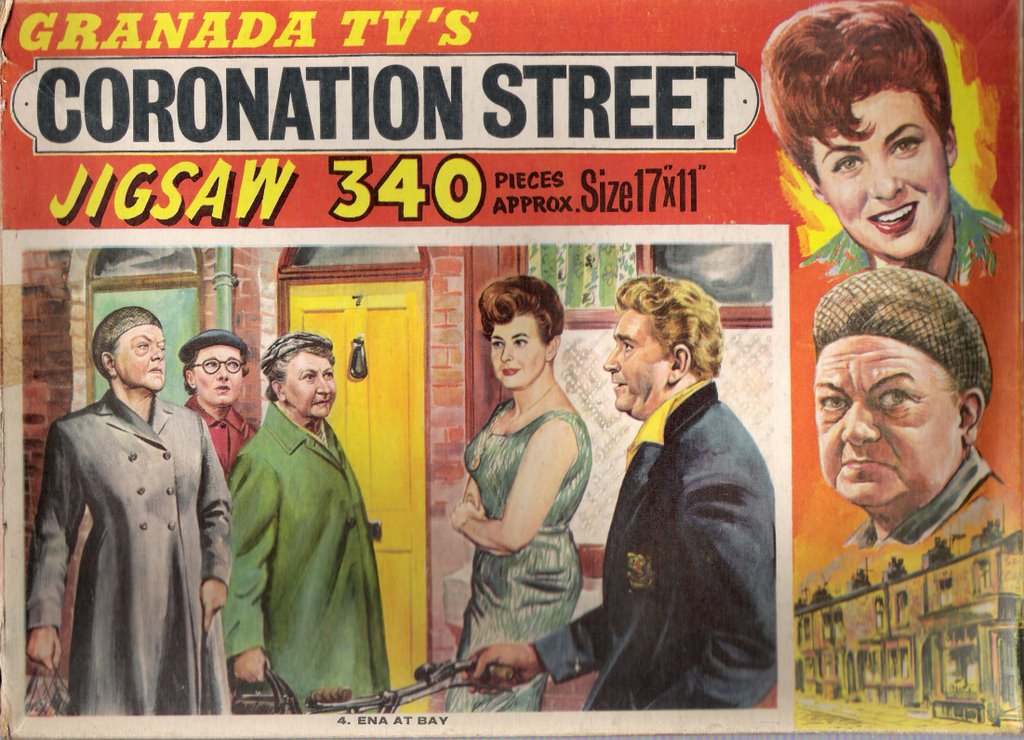
One of a series of jigsaw puzzles from c. 1963 featuring characters from Coronation Street. Note the street featured on the box, which is actually Archie Street, Ordsall - the original template for the Coronation Street architecture. English folklore has been greatly enriched by the addition of television soap opera characters like fearsome old dragon Ena Sharples and the glamorous and fiery Elsie Tanner.

The Street began on 9/12/1960, the creation of one Tony Warren, and continues to entertain a mass audience to this day.

The characters featured in this jigsaw have long departed. Ena Sharples (Violet Carson) left in 1980, and moved to Lytham St Anne's; Martha Longhurst (Lynne Carol) died in the snug of the Rovers Return in 1964; Minnie Caldwell (Margot Bryant) left to keep house for an old friend in 1976; Elsie Tanner (Pat Phoenix) left in 1984 to live in Portugal with an old flame; and Len Fairclough (Peter Adamson) died in a car crash in 1983.

Archie Street was demolished in 1971.