Showing posts with label Ena Sharples. Show all posts

Thursday, 27 October 2016

Albert Tatlock - The Unsung Hero...


We were having a cuppa in our Albert Tatlock mugs the other day, when we suddenly realised that Albert must rate as one of the most under appreciated Coronation Street characters of all time! Of course, Coronation Street has always been a matriarchal society, often dominated by grumpy old women (from the days of fiercesome Ena and vinegary Martha right up to acid Blanche) but the Street has also had a few grumpy gents in its time - remember the awfully officious Percy Sugden, bombastic scourge of the neighbourhood in the 1980s and 1990s? And then, of course, there's noxious Norris.

But the original grumpy old gent was dear old Albert Tatlock, of Number 1, Coronation Street.

Male characters in the Street do tend to be under appreciated. As we say, it's a matriarchal society, but nowadays it's also a misandrist society - both the Street and the real world. But the Street would have shrivelled and died without the likes of gentle Jack Walker, lovable louse Stan Ogden, loud and proud to be male Len Fairclough, jittery Jerry Booth and so on.

And not forgetting Ken Barlow - the Street's very own intellectual.

And so to Albert.

Jack Howarth was a fabulous actor. Albert could irritate, amuse, and bring us to tears. And Mr H seemed to bring about these emotions in his audience effortlessly.

How we laughed at Albert's attempts to get free chocolate back in the late 1970s. Some will remember him drunkenly singing "If I Ruled The World" while sliding down a lamp post to the pavement back in the 1960s. And his "comforting" visit to Mavis Riley while she was in her sick bed in the early 1980s - where he assured her she was looking "gaunt" - is a treasured memory.

Albert could be so funny.

Like all great soap characters, he was totally unaware of his own foibles. When he stated that Annie Walker never did have a sense of humour, he meant it.

But his moaning and groaning could be a real drag - after all, he fought a war for us lot, etc. Come to that, he did, and perhaps we were a let down. But I'll come to that later. And he was so mean, he would have skinned a flea.

But underneath it all, Albert was lovely. The character had great depth.

Remember his distress when faced with losing Ken from No 1 in 1981, when Ken was set to marry Deirdre, and the way he offered Ken his house if only he'd stay? All Albert wanted was to end his days in his own home, his own neighbourhood, and continue to be with a man he'd come to regard as his closest family. Remember his sadness and confusion as Ken and Deirdre's marriage hit its famous first rocky patch in the Baldwin Barlow triangle of 1983? We wept buckets.

There was such truth in Jack Howarth's acting.

Torn from his familiar surroundings and tipped into the hell of the First World War trenches as a young man, Albert won a Military Medal. Although he was fond of banging on about the war, he didn't discuss the bravery that won him his medal.

Elsie Tanner once told Albert that he was being unselfish, probably for the first time in his life, when he expressed concern about Ken's son Peter. Elsie, of course, could let her gob run away with her, that's one of the reasons we loved her, but Albert, who could probably have told her a great deal about unselfishness amd true comradeship, said nothing.

Albert's wife Bessie had died in 1959. His daughter Beattie and her husband Norman were not the most caring of souls, and so Albert lived alone with rare (and usually faintly grudging) visits from his nearest flesh and blood relative.

Albert was fond of his niece, Valerie, and had a bond with Ken Barlow which was already evident in episode 1. So, when Val and Ken married, Albert was delighted.

And he doted on Peter and Susan, his great nephew and niece who were born in 1965.

Albert and Ena Sharples had a deep bond of friendship, going back many years. Sometimes they were rivals, and if they spent too much time together they drove each other barmy, but the bond was definitely there and was not portrayed through a veil of sugary sentiment. When Ena was in hospital in a coma induced by a head injury in 1977, it was Albert who kept a vigil by her bedside, talking to her about the old days. As she said, when she finally gained consciousness: "I wish you'd make less noise."

The modern world let Albert down. The "Peace And Love" era of the 1960s - or perhaps in reality drug abuse, daft youthful idealism and increasing promiscuity posing as Peace and Love - were beyond him. As what former Street producer HV Kershaw described as the "Swinging 60s" turned into the "Savage 70s", Albert was so depressed, he locked himself in his house.

And the uncaring '70s found Albert, a poor old pensioner living alone, having his electricity supply cut off because he was unable to pay the bill. Fortunately, Ken came to the rescue, proving that blood is not always thicker than water as Beattie was noticeably absent from the scene and unaware of the crisis.

Albert was insecure. He felt fearful even of losing his beloved allotment.

Life was now about instant gratification. The rules that Albert had grown up with were rapidly eroded in the post Second World War world, and he didn't understand. How could Ken live out of wedlock with married Wendy Nightingale? When a poorly Albert was roughed up by a yob in his own back parlour in early 1979, many of us were also thoughtful about the current state of things.

In the vapid 21st Century, where looking up "facts" seems largely to revolve around unreliable sources such as Wikipedia, it is easy to dismiss Albert Tatlock as simply a grumpy old man. Indeed, at the time of his tenure in the show, he was often described as "a grumpy old git", etc. And of course Albert was merely a soap opera character - his grumpiness and canny way with pence were accentuated to give him colour, to make him interesting viewing. But back in the 1960s, 70s, and 80s he had many real life counterparts - those that had fought in the First World War for a better world, a "land fit for heroes", and found the reality sadly wanting.

Albert Tatlock was a piece of history, a character of depth who requires much more understanding than your average 21st Century web skimmer can give.

And Jack Howarth was one of the finest performers that Coronation Street has ever had.


Sunday, 17 August 2014

More About the Ena Sharples teapot...

Guy writes:

I enjoyed the post on your blog about the Ena Sharples teapot. I have spotted that there are a few variations on the design - including one with a slightly differently shaped handle, and one minus the bottle of stout and the glass on Ena's Snug bar table. Please would you publish a larger photo of your teapot so that I can study detail?

Certainly, Guy. My wife bought the teapot as a present for me around the late 1990s. She says she got it mail order. I'm sure they're around on eBay and such places. Very interesting to hear about the variations of design.

Saturday, 2 August 2014

Ena Sharples - 10th Anniversary Portrait

This lovely portrait of Violet Carson, in character as Ena Sharples, was one of a series commissioned by the TV Times magazine to celebrate Coronation Street's 10th anniversary in 1970. Other characters were featured over the ensuing weeks.

Ten years is a long time, and for Ena they had not been easy: she had faced the sad loss of her daughter Vera Lomax and her longtime friend and Rovers Snug companion Martha Longhurst; she had been buried in rubble when a train crashed off the viaduct; she had almost been killed in a coach crash; she had fought many battles with the fiery Elsie Tanner; her vestry home at the Glad Tidings Mission Hall had been vandalised and later demolished...

In the opening years, Ena was rather a scary figure and not terribly pleasant to have around (well, not for the other residents of the Street, but a WOW for viewers!). However, as the 1960s had continued, she had mellowed and, although still capable of epic battle, had become a much-loved and respected figure, a soap legend.

Violet Carson commented in 1970:

"Ena's still the battleaxe she was ten years ago, but she does have a heart of gold, and the mellow side of Ena has come out much more lately. Over the years I have tried not to let Ena's character overwhelm me. I've done my best to keep Ena and me well apart. Otherwise, by now, she would have taken me over."

Sunday, 13 October 2013

Violet Carson on Ena Sharples...


 Violet Carson at home with Ena Sharples.

When I was a kid in the 1970s, Ena Sharples of Coronation Street was a lovely character. OK, she could speak out occasionally - as when Bet Lynch moved in with Mike Baldwin as his... er... "housekeeper" in 1976, but, in the main, Ena was a very lovable figure, cherished by the community around her.

It wasn't always so, of course. The original Ena Sharples of the crackling black and white days of the early 1960s had been a fiercesome, fiesty harridan, often completely unreasonable, often almost foaming-at-the-mouth.

I was unaware of that Ena until the mid-1970s. I wasn't born until 1965, you see, and, being so young, had no memory of the days when Ena had told Elsie Tanner, Florrie Lindley, Christine Hardman and many, many others where to get off.

Then, one bleak mid-1970s Christmas, I saw an episode of the Street in which Annie Walker and Betty Turpin reminisced about days gone by in Weatherfield. The episode was largely composed of flashbacks and there, suddenly, was Ena, in a hospital bed in 1960, letting her "friend" Martha Longhurst have it, all guns blazing. Ena's awesome tirade ended with her furious face close up to the camera, and I found myself shrinking away from the TV set. It was almost a "duck behind the sofa" Dr Who-style moment!

After that episode, I looked upon Mrs Sharples rather differently!

WOW! What a baggage she had been!

During the 1970s, a gentler and far more reflective Ena was often absent from the Street as Violet Carson's health declined, and she made her final appearance in 1980. Not that it was planned that way, and Ena's departure that year was low key as it was fully intended she would return.

Violet Carson died in 1983.

So, how did she become Ena? What did she think of Ena? What was Vi Carson really like? Here are a few choice observations from the actress who created a soap legend...

ON ENTERING SHOW BUSINESS:

As young girl, Vi had learned to play the piano, and her sister, Nellie, was learning the violin...

"Harold Jones, the musician who was teaching Nellie, was leading the orchestra at the old Market Street cinema in Manchester. One day, they wanted a relief pianist in a rush - they always want you in a rush or not at all - and Harold suddenly said, 'Send Vi down and see what she can make of it.' I was petrified with fright. I was only fifteen and I clutched the sheaf of music so hard it was all squashed out of shape. But once I put my fingers on the keyboard, everything seemed to come right. In fact, they gave me the job on the spot and I stayed for two wonderful years."

ON BECOMING ENA:

"When this 'Ena' thing cropped up I didn't want to know. I was getting out of the Northern scene - not that I despised it. I am fiercely North Country (being Mancunian). But I was moving. The magic of Shakespeare swept me off my feet. And then I'm back saying 'Eee, by gum' in the Street. It has trapped me. It has made me, if you like. But it has destroyed me. Nobody sees me or anything about me..."

"When they said she was difficult to play, and they couldn't find anybody to play her, I said: 'Don't be ridiculous. I've lived with this woman all my life.' There's one in every street, every town, every country in the world. She's always there. She pontificates. She routs those who won't work. She praises those who will. She's there when there's a new baby. There if anybody's sick. We had one next door when I was a little girl. When anything was wrong, she was there. I said to them at Granada: 'Why do you find this casting difficult?' They'd had twenty-four actresses down for the thing. It was ridiculous.

"I said I was too large for the part. That it was written for a little woman. It wasn't until afterwards that I found Tony Warren had based the character on his grandmother, a big woman. That is why the others had fallen down. I romped home. It was easy. I was back in my childhood with the woman next door. And that was it."

ON HER SIMILARITIES TO ENA:

"I'm a bit like her. I don't suffer fools gladly. I can't stand hypocrisy. I'm a plain Jane really, like she is. I speak my mind. I actually like household chores such as cleaning the fire grate But in lifestyle and outlook she and I are poles apart.".

ON MILK STOUT:

"I loathe milk stout. I only pretend to drink it in the Rovers. I like good food and brandy and ginger is my favourite tipple."

ON BEING OVERSHADOWED BY "SHARPLES":

Vi had a long career before Ena Sharples, including six years as pianist for Wilfred Pickles on the popular radio show Have A Go! There is no doubt that Ena eclipsed that success and in some ways eclipsed the real Violet Carson, the actress, the personality. Back in the early 1960s, with the Street just beginning to take off, Vi said:

"I don't want to be Sharples - that old bag - all my life. I want people to remember Violet Carson."

I think Violet was a victim of her own success. Had she not been such a fine actress, then Ena would never have become the legend she was - and, indeed, still is - and would never have been able to eclipse the already established media personality who played her in the eyes of the public.


Friday, 4 October 2013

Ena Sharples - The Teapot!


My Ena Sharples teapot - a comforting presence?!

Today, lovies, Andy is not feeling very well. In fact, I've had a stinking cold for a week now. The onset on the symptoms began last Saturday, which was my last day at work before beginning a week's holiday, and I've been feeling dog-rough ever since. Great timing, eh?

Anyway, today, as I snuffled my way through a box of Kleenex, my loving wife left me to go to her place of work with the following expression of sympathy: "Don't forget the dusting and hoovering, will you, darling?"

Being a thoroughly good lad, well brought up, I've been flicking a duster around.

You know what it's like when you've had a picture or ornament for years? You don't really see it? It just doesn't register as you waltz through your day-to-day to round? Well, today, I suddenly became aware of an ornament in our hall - an Ena Sharples teapot my wife bought when Adam were a lad, and the expression on said Mrs Sharples' face, as depicted on't teapot, made me feel quite Minnie Caldwell for a moment!

"Oooh, Ena!" I said.

Anyway, I thought you might like to see the teapot, which was made by the Bovey Pottery Co and created by Peter Rogers. Lovely, innit?!

This brings me on to the fact that I have some great Violet Carson Ena Sharples material lined up for this blog. It'll be here very soon.

I'd put it on today. But I've clinkers to riddle and pots to side.

Saturday, 6 July 2013

On The Menu To Celebrate the 2000th Episode...

Here's the Sun newspaper's wonderful cartoon image of Ena Sharples jumping out of a cake to celebrate the 2000th episode of Coronation Street in 1980. But what was REALLY on the celebration menu? Well, we took a peek, and would you believe there wasn't a barm cake to be had? Nope, the big nosh-up included smoked salmon, saddle of lamb and "strawberry surprise" (whatever THAT was!).

Eee, lovey, weren't it posh?!

The mouth watering menu for the great 2000th episode celebration...

Monday, 8 April 2013

Ena Sharples After A Few Milk Stouts Too Many?!

Titbits, June 1968. What a wonderful cover - Mrs Sharples looking super jolly with a thick coating of lippy! The article inside centres on the serious consequences of real-life gossip, but the cover is so flamin' funny we've filed it under "wot a laugh, lovey!"

Thursday, 21 January 2010

1983: Dishing The Dirt On Elsie Tanner's Past...

Life in Coronation Street didn't begin on 9 December 1960. Eee, no, lovey - the residents had pasts stretching back to when Adam were a lad.

And some of 'em were a bit on't seamy side (sniffs disapprovingly).

Take that Elsie Tanner in't 1940s - skirts up to 'ere and 'got any gum, chum?'.

From the Sunday Mirror, August 14, 1983:

Your Coronation Street favourites have secret pasts - going back long before the start 22 years ago of Britain's most popular TV series. They are documented in Granada TV's confidential files on the Street stars. The dossiers are updated after each week's episodes so that writers can avoid factual errors in future scripts.

But it is the past "lives" of the Coronation Street regulars - built up to give them believable backgrounds - that makes the most fascinating reading. These Secret Lives have never before been made public. Now you can read all about them in this intriguing Sunday Mirror series.

It is 1942 - We'll Meet Again time - and the Yanks are overpaid, over-sexed and over at Elsie Tanner's.

Ena Sharples watches, clucking disapprovingly, as a procession of servicemen bearing everything from nylons to chocolates, comes and goes at No. 11 Coronation Street.

Flame-haired Elsie is well and truly launched on her career as the Street's scarlet woman.

Hair-netted Ena had seen it all coming. That little minx, Elsie Grimshaw as was, had never been able to resist anything in trousers.

By the time Elsie was 16, the inevitable had happened. She was pregnant by a tearaway called Arnold Tanner. He did the decent thing and married her on October 4, 1939.

The couple moved into No. 11 where, on January 8, 1940, their daughter, Linda, was born. Soon afterwards Arnold went off to join the Merchant Navy.

From then onwards, he sent Elsie money regularly but was rarely seen again. She wasn't one to sit and pine. Or to be lonely.

As often as Elsie could recruit a babysitter, she went out on the town.

In 1941, though, Elsie had to stay at home for two whole months when Arnold put in one of his rare appearances. Their son, Dennis, was born the following year.

That year, 1942, was when the Yanks "invaded". Soon word was out at the bases that there was a warm-hearted girl in Coronation Street running a one-woman "hands-across-the-sea" crusade.

Among the Yanks beating a path to Elsie's ever-open door was a handsome Master Sergeant called, coincidentally, Steve Tanner. He and Elsie made beautiful music together... and they weren't talking about Glenn Miller.

The end of the war brought little rejoicing for Elsie and Arnold. When he came home, they fought like cat and dog. And it wasn't long before Arnold found a new love and went once more a-roving.

The only time Elsie saw him again was in 1961, when he turned up to ask her for a divorce. Elsie agreed and settled joyfully into her new role as a fancy free bachelor girl.

Viewers will recall how she turned down two proposals from a besotted Len Fairclough.

Then with all the shock of a bomb going off, Master Sergeant Steve Tanner exploded back into Elsie's life and swept her into matrimony.

Elsie thought it wouldn't last. As usual, she was right. The marriage was never a going concern and it ended in tragedy when the American was murdered.

Elsie tried marriage once more - to Alan Howard. They were divorced in March 1978, and Coronation Street's scarlet woman, now 60, is alone again.

Judging by a few novels I have read recently, based on the Street in wartime, I think that some of these details have been revised since the 1980s. But these were the facts regarding Elsie's past as they stood during Pat Phoenix's reign in The Street, and the facts I was familiar with through watching the show (Elsie's past was often referred to!) and through reading the HV Kershaw Coronation Street novels.

Read about Eric Rosser, the original Corrie archivist, here.

More from this fascinating newspaper series soon.

Saturday, 2 January 2010

1976: The Naughty Night Out...

It began, as did so many things, with Mavis Riley (Thelma Barlow). Her Auntie Edie was away from home for a few nights and Mavis was nervous, being alone in the house. Good Samaritan Emily Bishop (Eileen Derbyshire) came to her rescue - Mavis must stay at No 3 with herself and Ernest (Stephen Hancock) until Auntie returned.

It was Emily and Ernie's wedding anniversary, but that didn't matter.

Mavis was more than welcome.

And Emily said so without consulting her nearest and dearest.

Ernest was horrified and sought refuge in The Rovers, where Alf Roberts (Bryan Mosely) and Ray Langton (Neville Buswell) came up with a tempting alternative: why not come to The Gatsby with them? There was a special Easter Monday stag night - "The Ties Only" Club - and strippers galore would be in attendance.

Back to No 3 went our intrepid hero, to tell Emily that he'd agreed to play the piano at the Easter Monday concert at The British Legion. They had an extension, so it was going on quite late.

When Mavis pointed out that it was a good job she was there, because Emily would have been alone otherwise, Emily, who knew Ernie was only making himself scarce because of Mavis's presence, could only agree with a grimace.

Still, the two women made the most of things, and settled down to an enjoyable session of tea and gossip.

"According to Mrs Waters, he's still living there..." said Mavis.

At The Gatsby there was naked female flesh in abundance. And Fatima, "Miss Rising Blood Pressure 1976", took quite a shine to Ernie - who was delighted and stunned.

It was a very excellent evening.

An evening of flesh and tassels.

And then, as the final act, "Madame Ultimate", was just about to make her entrance, the police swooped. The Gatsby, which had exceeded its extension of hours for its fleshy jollities that night, was raided by the police.

And, before you could blink, Bet Lynch (Julie Goodyear) was reading the tale of "The Ties Only Club" to the assembled regulars at The Rovers Return.

The Gazette
had done its job well - but not as far as Annie Walker (Doris Speed) was concerned. The "Ties Only" article featured a photograph of former mayor Alf Roberts, with Annie, his mayoress, taken during his reign.

Annie was terribly upset. Obviously, some of her lady victualler friends and regulars would think that the photograph had been taken the night before at The Gatsby - and that she had been there!

Alf Roberts, sorry, councillor Alf Roberts, was so embarrassed. Ray Langton thought it was funny - until Deirdre (Anne Kirkbride) resorted to domestic violence, slinging some wedding present crockery at him and cutting his face.

Meanwhile, Emily left Ernest in no doubt about her feelings regarding his slinking off to his "peculiar dives".

And him a lay preacher on the local Mission circuit!

When Ernest pointed out that he would have spent the evening with her if she had not invited Mavis to stay without consulting him, Emily told him he was being unreasonable.

Mavis had been dispatched back to Auntie Edie's by Ernest, leaving the couple free to wage war.

Emily told Ernest that his going to the stag night at The Gatsby had been the "grossest and vilest insult" to her. He'd gone to watch some "painted whore" when he could have been with her.

She frowned down on him furiously, her halo throbbing.

Ernest sought refuge at the pub. And when he returned...

... discovered that Emily had locked him out of the marital home.

Good neighbour Len Fairclough (Peter Adamson) took Ernest in. He didn't take the bust-up at No 3 seriously.

However the situation wasn't helped by Elsie Howard (Patricia Phoenix), who called round with a jumper she'd bought as a present for Len. Sadly, it didn't fit, so Elsie decided that Ernest could try it on. She assisted him. And that was the moment Emily walked in, to find the Street's scarlet woman giggling and grappling with her husband.

Frosty Emily rose high above them.

She told Ernest that she'd simply called to bring him some of his clothes - it would save him having to call at No 3 for them...

The frost seemed set, hard and permanent, but soon Emily relented enough for Ernest to return home.

However, she made it plain he had not been forgiven. Oh dear me, no!

The frost had thawed. But only slightly.

"Everything's spoilt, Ernest, don't you realise that? Nothing'll be quite the same again - never quite knowing if you're lying me!"

And then came the news that Mr Mortlake, the Mission superintendent, was going to be paying Ernest a little visit. Word about The Gatsby fiasco had swept the gossiping back streets of Weatherfield, and now Ernest's position as a lay preacher was in peril.

Help came from an unexpected source - Mrs Ena Sharples (Violet Carson).

The Ena Sharples of the 1960s would have probably descended on Ernest from a great height, heaping coals of fire on his poor defenceless head.

But the Ena Sharples of the 1970s was an altogether milder and wiser creature. She saw Ernest's brief departure from the Narrow Path for what it was - a daft one-off, and didn't see why a genuinely religious man, an excellent preacher, should be lost from the local Mission circuit.

She reminded Ernest of Lord Longford and his fight against "filth" - Ernest got her point - Lord Longford had openly sought out "filth" on occasion to see what he was fighting against!

If Fatima the Gatsby stripper, was Weatherfield's "Miss Rising Blood Pressure 1976", then Emily was definitely its "Miss Victoriana". She didn't want Ernest to lie to Mr Mortlake. Ernest said he wouldn't be lying - just bending the truth. He did a lot of good work for the mission and didn't see why he should be drummed out of service because of one silly incident.

Emily was most displeased.

When Mr Mortlake arrived, Emily stood by, looking like a cross between the author of the Country Diary Of An Edwardian Lady and The Hanging Judge.

Ivor Mortlake was played by Frank Mills, later Betty Turpin's husband, Billy Williams.

Mr Mortlake was grave. At first. One of their lay preachers... a well respected one at that... caught in what can only be described as extremely unfortunate circumstances...

Things looked grim for preacher Ernest.

Ernest asked Mr Mortlake if he knew of Lord Longford? Of course, Mr Mortlake did, and heartily endorsed his work.

And then Ernest fed Mr M. Ena's inspired tale that he, Ernest, had gone to The Gatsby for the same reasons - to seek out filth, to see what he and the Mission were up against with his own eyes. He hadn't wanted to go, he'd been practically dragged there, but gone he had, out of a sense of a duty.

And he was now all the better to fight the goodly, Godly battle.

"You can fight more effectively if you know a bit about your adversary. You can't just read the Sunday papers."

Mr Mortlake declared that Ernest's story had thrown a different light on things.

"And you're going to do a sermon on it, are you?" he asked.

"Yes, yes, I am," said Ernest.

"Only one, Ernest? Seems such a waste of material," sniped Emily.

"So you don't propose to pay another visit?" asked Mr Mortlake.

"Oh, no..."

"Well not to strip clubs," Emily's face was screwed up with sarcasm. "His next target's blue films, isn't it, Ernest?"

"Really?" said Mr Mortlake, very interested indeed.

After a cup of tea, he gave Ernest some final words of reassurance:

"Somebody has to do these tasks. And when there's a good explanation..."

And he assured Ernest that the Mission committee would feel the same as himself.

As he picked up his jacket to leave, Mr Mortlake asked: "By the way, are these places really as bad as people say?"

"Well..." said Ernest.

Mr Mortlake continued: "No, I mean, between you and me, like, what does happen on stag nights?"

Ernest took the moral high ground just vacated by Emily, who had left the room: "I'm surprised at you asking me a question like that, Ivor, I really am!"

"Now, don't get me wrong, Ernest, I'm only asking. I've never been inside one of these places, but from what you tell me I feel I've got a duty to... well, you see what I mean."

Ernest saw only too well. "Stag night at The Gatsby is Tuesday."

"Tuesday..." mused Mr Mortlake, mentally checking his availability that night...

Later, in The Rovers, Ena told Ernest that she wasn't proud of helping him in the way she had, and added: "But I just happen to think there's much worse than the likes of you in this world, Ernest Bishop."

As she spoke, as if to underline her point, Stanley Ogden (Bernard Youens) came staggering in, reeling drunk.

"Much worse!" said Ena, grimly.

Slowly, Emily's frostiness thawed at No 3.

Ernest told her that she was such a perfectionist, he was just a frail human being. He sometimes found her standards impossible to live up to.

Whether Mission superintendent Mr Mortlake attended The Gatsby stag night, all in the name of the Lord's work of course, is not known.

But "The Ties Only Club" definitely had to make do without Ernest from then on.

Monday, 7 September 2009

Ena Sharples And The High Rise Photograph - The Details...

I had an e-mail the other day that said some very charming things about this blog.

Very appreciative indeed it was.

So, I chortled in reply:

"My dear! But of course - this is The Annie Walker, The Gatsby, The White Swan, The... er... Laughing Donkey of retro Corrie blogs. Nothing is spared, no expense spent, in our quest to bring you somethin' you might fancy 'avin' a bit of a read of every now and then."

And every word of what I wrote to my appreciative audience of one is absolutely true.

And so, in our great tradition of sheer ruddy brilliance, we bring you the full details of the Ena-Sharples-on-a-high-rise balcony-in-the-1960s photograph.

Ena found her tenure as live-in caretaker at the Glad Tidings Mission Hall threatened in 1966. So, where would she live now? In a high rise block, perhaps?

Photographer John C Madden took the high rise photograph of Ena. The so-called "slum clearances" in Manchester were well underway by the mid-1960s.

In Moss Side, the area near Cornbrook Street had begun its transformation in the early-to-mid 1960s. The first new high rise blocks were named after the old streets they were replacing - Pickford Street, Clifford Street and Grafton Street were commemorated as Pickford Court, Clifford Court and Grafton Court.

And so there in Moss Side it was that Violet Carson posed as high rise Ena. With the rest of the old neighbourhood still intact and the gloriously industrial-looking Hydes Brewery in the background, this was the ideal setting for Weatherfield, which, as you will recall, succumbed to a few high rise flats, but not many.

The wide, busy road in the Ena photo was Cornbrook Street. And it's absolutely vanished.

Ah, you screech, but Cornbrook Street still exists - so how could it have vanished? Well, actually, lovey, part of Cornbrook Street still exists. It used to continue on the other side of the junction with Chorlton Road and ran up to Moss Lane West.

The part of Cornbrook Street seen below Ena is now parkland and modern housing.

The religious-looking building in the photograph was St Bride's Church of England Primary School, and the street with the replaced roof tiles was Dudley Street.

The chimney pots and brewery on Moss Lane West can be seen in the smoggy distance.

It was a different world.

Monday, 24 August 2009

Said In The '70s - Part 3

1976: Tricia Hopkins (Kathy Jones) and Gail Potter (Helen Worth) are working together in the Corner Shop. Ena Sharples (Violet Carson) has just come into the shop to make a purchase, and the recently-returned Elsie Howard (Pat Phoenix) is the subject of conversation.

Tricia thinks that Gail is jealous of Elsie's glamorous appearance. Gail is outraged.

Gail: "Jealous?! What, of somebody 'er age?!!"

Tricia: "I'd like to see you when you're 'er age. You're grotty enough now!"

Gail: "Have you seen yourself lately?!"

Ena (annoyed): "Look, I don't like to break up a first class row, but would somebody give me a packet of tea?"

Thursday, 13 August 2009

Holiday Time!

Holiday time - Minnie Caldwell (Margot Bryant) and Ena Sharples (Violet Carson) take a holiday at home. Minnie wears her "Kiss Me Quick" hat!

Well, I'm off on me hols - Hunstanton beckons.

"You're holidaying in England?!" an American pal of mine said last night.

Well, yes. A holiday isn't a holiday to me without a nice stick of rock and a rain-lashed beach!

Next week, I'll start the 1976 Revisited series of posts. Until then, whatever you're doing, I hope you enjoy it!

xxxx

Friday, 24 July 2009

Ena Sharples - 1960 To 1980, First To Last...

The first episode: "I'm Mrs Sharples..." Ena (Violet Carson) introduces herself to Florrie Lindley (Betty Alberge), the new owner of the Corner Shop. 1980 - Ena departs: "I never was one to stay anywhere where I wasn't wanted. I'm off first thing in't morning!"

I had a question in the blog comments today:

Has anyone seen Ena's final appearance on the street?

Yes, I have a copy of the episode. No great farewell for Ena, I'm afraid, as nobody suspected that Violet Carson was making her final appearance - not even Miss Carson.

Ena returned to the Street after a short spell away to find that the Council had not finished redecorating her flat at the Community Centre.

After a brief stay with Elsie Tanner (Pat Phoenix), and facing the prospect of a stay at No 1, much to the chagrin of Albert Tatlock (Jack Howarth), Ena announced to Albert and Ken Barlow (William Roache): "I've been on the phone to Mr Foster. He says he'd be very glad to see me."

"Oh, I see!" said Ken, "Yes, perhaps you would be better off in St Anne's and happier there, wouldn't you? I'll let you know the minute the decorators move out!"

"You've no need to bother," said Ena.

"Sorry, I don't follow you?" Ken was totally puzzled.

"I've been mucked up by you and your committee for long enough. I'll be the one to say when I come back, if I come back!"

"What do you mean - 'if' you come back?!" asked Albert.

"I'm fast coming to the conclusion, Albert Tatlock, that the air up there is much more to my liking than it is round 'ere these days. And you can take that any way you like! I don't suppose either of you thought of puttin' the kettle on, did yer?" and she disappeared into the kitchen. And into Street history.

Albert had seen her leave the Street in high dudgeon before and didn't take her seriously. He actually laughed in response! Ena had been absent from the Street for lengthy periods several times during the previous decade. But she had always returned.

And in fact Violet Carson would wear that famous hairnet one last time. She appeared on the cover and within the pages of a TV Times magazine - Coronation Street 2000 - which celebrated the screening of the show's 2000th episode in June 1980.

1960s glory days: Ena, a poor, vulnerable old woman (!) in hospital, suspects that her friend Martha Longhurst (Lynne Carol) is a snake in the grass: "You, you, you, Martha Longhurst, you snake - I know what you're after, you're after me vestry!"

Ena was a howling harridan in the early episodes!

When Ena announced that she may not be coming back in 1980, Albert Tatlock (Jack Howarth) actually laughed! He'd heard it all before.

Ena's glower was a trademark of the character in the 1960s, but rarely glimpsed after that. During her final episode in 1980, she bestowed the famous look on Fred Gee (Fred Feast).

Tuesday, 21 July 2009

1965: Violet Carson, OBE

Violet Carson and singer Frankie Vaughan with their OBEs at Buckingham Palace, 1965.

Ena Sharples was, and is, quite simply a Coronation Street legend.

Played by Violet Carson, Ena appeared in the very first episode of Coronation Street, lambasting new Corner Shop owner Florrie Lindley (Betty Alberge). In that first episode, she didn't wear a hairnet. But that quickly followed.

Early Ena was a fiery treat, a real harridan, with nowt good to say about her neighbours and, in particular, Mrs Elsie Tanner (Patricia Phoenix) of No 11. Clashes between Ena and Elsie in those early days still make breath taking viewing today.

Ena sat in the snug at the Rovers in the early years, with her two pals, Minnie Caldwell (Margot Bryant) and Martha Longhurst (Lynne Carol), providing the show with many a moment of high class comedy. What a trio they were! Ena headed the group, vinegary Martha often sought to usurp her, but never succeeded, and Minnie was largely away with the fairies.

Over the years, Ena mellowed more than somewhat. Never afraid to speak her mind, and a stern upholder of "good", old fashioned morals, Ena was also a friend and confidante to many. And her relationship with Elsie evolved - these two very strong, very different woman, developed a respect and fondness for each other, and when Ena found herself temporarily homeless in 1980, it was Elsie who came forward to offer her a roof over her head.

Ill health caused Violet Carson to take several lengthy breaks from the show in the 1970s, and when she made her final appearance in 1980, none of us were aware of the fact that we had seen the last of the glorious old battle-axe.

Ena was in her heyday in the 1960s, and in October 1965 that fact, and Violet Carson's long career in show business before The Street, were recognised when Miss Carson was awarded the OBE.

From The Real Coronation Street, by Ken Irwin, 1970:

When Violet Carson received an important-looking envelope bearing the Royal crest through the post at her home in Blackpool, one morning in the autumn of 1965, she had absolutely no idea what it might be.

She even hesitated before opening it. Then, with much surprise, her trembling fingers pulled out the official notification - she was to be awarded the OBE by the Queen.

She was stunned but immensely pleased. Yet a little puzzled. She could not explain the Royal award. "I do not know why I have been singled out," she said. "I would like to think that it was some sort of recognition for the whole of my career. People tell me I have managed to make a lot of folk happy. I hope I have."

The Real Coronation Street by Ken Irwin, the Daily Mirror TV critic who declared that Coronation Street had "little reality" and was "doomed from the outset" back in 1960! The book - "The fascinating, true story behind a TV serial and how it has affected the lives of the actors involved in it over a period of ten years" - sometimes pops up on eBay and is well worth a read.

Monday, 2 March 2009

Minnie Caldwell And Her Bobby

Was there ever such a sweet and gentle soul as Minnie Caldwell, who moved into No 5 Coronation Street from nearby Jubilee Terrace in 1962? Already well known in the Street as a Rovers regular, the widow Caldwell had cared for her invalid mother for years, and was a long-time friend to Ena Sharples, who lived in the vestry at the Glad Tidings Mission Hall, and Martha Longhurst of Mawdsley Street.

The three old ladies were, on most days, to be found in their second home, the Snug bar at the Rovers, drinking milk stout, keeping an eye on their neighbours, and gossiping. Well, that is to say, Ena and Martha gossiped - Minnie would usually sit there, smiling obliviously, and chipping in with occasional, often inappropriate, comments. A bit "away with the fairies" was our Minnie.

Whereas Ena and Martha's views on life and human nature were pickled in vinegar, Minnie beamed sweetly on all and sundry, seeing life as something rather lovely.

Margot Bryant, the actress behind Minnie Caldwell, was a member of the original Coronation Street cast, and made her on-screen debut in episode two.

Jean Alexander (Hilda Ogden) recalled how the character of Minnie originated and developed in her 1989 autobiography, The Other Side Of The Street:

Her introduction to Coronation Street was as an extra - an old lady who never said a word but submitted to Ena Sharples's withering comments on her intelligence. Then she was occasionally given the odd line which, in her inimitable way, she made funny; and so Minnie Caldwell became the character who earned so much sympathy from the viewers. What they did not know was Margot's ability to forget key words in her dialogue and substitute others that frequently made no sense. "My father had a dog once," she said. "It was a ferret..."

In the story, Minnie had always loved cats and the wedding present from her husband, Armistead, was a small, tabby kitten. Minnie and Armistead were not blessed with children, much as they would have liked them, and so the Caldwell household always included a cat for Minnie to dote on.

When she moved into Coronation Street, she brought with her a large ginger tom called Bobby. As Street producer and writer Harry Kershaw observed in his 1977 Corrie novel, Early Days, Minnie would have "cheerfully died before inflicting the slightest pain on Bobby"!

Bobby first appeared in The Street in 1962, and was originally to be called "Skippy", but Margot changed the name to Bobby. The original Bobby (left) was actually called Toby!

Toby died in 1968, and Margot Bryant was deeply upset. In the story-line, Minnie's Bobby disappeared. She thought she spotted him up on the viaduct and Stan Ogden rescued him, getting scratched in the process. Sadly the viaduct moggy was not Bobby. However, the cat was a stray and Minnie adopted him, calling him "Sonny Jim" (or "Sunny Jim", if you prefer!), which had been her affectionate nickname for her lodger, Jed Stone.

In 1969, with a little nudge from Ena Sharples, Minnie renamed the viaduct stray "Bobby".

The new Bobby did not endear himself to Albert Tatlock when he ate Albert's pigeon, Gilbert, in 1975!

Unlike Minnie, Margot Bryant never married, but, just like Minnie, she absolutely adored cats. When Eileen Derbyshire (Emily Nugent/Bishop) brought her new baby into the studios, Margot commented: "What a pity it isn't a kitten!" She took cat food out to feed the hungry strays of Venice, and grandly dubbed her own large ginger tom "The Earl of Hammersmith". She adored him so much, she gave him a life peerage, and was devastated when he died at the age of eleven.

"Of course cats understand me," she once said. "Cats are super-intelligent animals. It depends on how you treat them. If you never spoke to a child, it would never learn anything. It's just the same with cats. If you speak to them all their lives, then they understand you."

Oh dear - Minnie's in trouble! Another happy evening in the Snug at The Rovers with Ena and Martha. Ena (Violet Carson) ruled the roost, Martha (Lynne Carol) constantly sought to usurp her, but never succeeded, and Minnie, at first glance, seemed the helpless focus of barbed comments from her two "friends". But the situation, according to Harry Kershaw, was a little more complex than that. He once wrote that Minnie saved her biting wit for appropriate moments, and then her barbed comments had an edge that even Ena envied!

But despite this, a worrying weakness for gambling, and a prominent stubborn streak, Minnie was mainly sweet, meek and mild. However, Margot Bryant was exactly the opposite. "I'm tough. Very tough," she once said. Miss Bryant was well known for her tendency to prove this statement, and for her usage of what Corrie Producer Bill Podmore called "barrack room expletives". Ken Irwin in his 1970 book The Real Coronation Street, entitled his chapter on Margot Bryant The Pussy-Cat Lady... With Fangs Of Her Own.

Many are the stories detailing Margot's "tough" side and I must say when I first read of it, I was stunned. Her playing of Minnie Caldwell was so effective, the character's air of simplicity and meekness flowing out of the TV screen so strong, that I found it hard to believe Miss Bryant's own character was so different.

I can only put it down to superb acting!

Born in Hull, doctor's daughter Margot followed her sister onto the stage. During her years as Minnie Caldwell, she bought a flat in Brighton (or Hove, according to one source), rented another in the Hammersmith district of London, and displayed a strong spirit of adventure - travelling all over the world. Her love of travel came about during her time as an entertainer with ENSA during World War II. Of the Coronation Street cast, she was probably most friendly with Jean Alexander - who shared her love of cats!

Back to the on-screen story: Jed Stone was a cheeky Scouse lad, out to make a bit of brass, and not too choosy about how he went about it. Of course, he had a heart of gold and was devoted to Minnie. He called her "Ma", she called him "Sonny Jim", and he moved into No 5 as a sort of lodger/substitute son figure.

Minnie was heartbroken when he went to prison for receiving stolen blankets in 1966.

Kenneth Cope, who played Jed, presented the Margot Bryant tribute programme Remembering Minnie Caldwell, after her death in 1988. In the 1990s, he said: "I think Margot liked Jed because it gave her a good story-line. If she had a lodger she suddenly wasn't one of a trio, she had a background which was not necessarily involved with the three of them in the Snug. I found playing with her smashing because I could rabbit on quickly and she'd bring me back with the slowness of it all."

Eek!! December 1970, and Minnie and Bobby were held hostage by American serviceman Joe Donnelli (Shane Rimmer). Joe had murdered Steve Tanner in 1968. Lodging with Minnie in 1970, he pulled out a gun and confessed. It was a messy affair - far different from the usual evenings at No 5, with Bobby lazing by the fire whilst Minnie told him the day's events. Stan Ogden became involved and, finally, Joe turned the gun and shot himself.

April 1976, and Rita Littlewood (Barbara Mullaney) had a bit of a gob on her because of yet another hitch in her stormy love life. Because of this, she was uncharacteristically hard-hearted when Minnie dithered over choosing an Easter egg for a friend's great-niece. Rita told her, quite forcefully, that she really hadn't the time to stand there whilst Minnie agonised over two eggs which were basically the same.

The Kabin scene occurred in Margot's penultimate Corrie episode, broadcast in April 1976, and was, I believe, the very last time Minnie was bullied in Weatherfield!

Minnie was absent for some months, and the story was spun that she was away staying with an old friend called Handel Gartside (Harry Markham), who had appeared in the show some years before. In October '76, Handel turned up in the Street to tell Ena that Minnie was staying with him. The reason for Minnie's non-return to say her farewells was, apparently, that she wanted to give Ena no chance to persuade her to stay at No 5.

The real-life reason behind Minnie's absence from her own on-screen farewell was that Margot Bryant had been in increasingly poor health for some years and was having great difficulty in remembering her lines. Street Producer Bill Podmore wrote in his autobiography, Coronation Street - The Inside Story (1990), about Margot's return to The Street after a period of illness:

Margot came back for a while, but it became increasingly difficult for her to memorise her lines. She began cutting them from the script and sticking them to the back of her handbag. But when it became obvious to everyone that she was reading during a recording, it had sadly reached the stage where it would have been unfair to ask her to carry on a moment longer. She wasn't at all well. There were more periods of illness, until finally we found her a place in a beautiful Cheshire nursing home where she spent the remainder of her days happily and in comfort.

Back to Minnie's final departure in the story-line of 1976, and Handel Gartside told Ena that Minnie would like her to have some item of her personal paraphernalia as a keepsake. Ena selected a picture of a cat (of course!) which had hung in Minnie's living room for many years - one of several!

"Take care of her for me..." - Ena, speaking to Handel Gartside.

Despite her bullying ways, particularly in the Street's early years, Ena cared a great deal for Minnie. And Minnie had said, back in 1969: "I wouldn't like to live to be a hundred. Ena mightn't be alive. And I wouldn't want to be alive if Ena wasn't alive."

The two women had been friends for many years and, when times were hard or personal problems pressing, had always been there for each other.

Ena closes Minnie's door for the last time. When she next visits the house, it will belong to a brash London businessman called Michael Vernon Baldwin.

Things certainly changed, as Mike's brief time at the house - shared out of wedlock with Rovers barmaid Bet Lynch - was followed by the Langtons' - Ray, Deirdre and baby Tracy's - brief "happy families" era (before Deirdre was attacked under the viaduct and Ray had an affair), then by the turbulent Tilsleys.

Minnie - and, of course, her Bobby - faded into Street history. And, in today's Coronation Street of explosions and serial killers, a very distant piece of Street history they seem!

This blog post is dedicated to the memory of Margot Bryant - 1897-1988.

Sunday, 9 November 2008

Rosamund Street, 1963

A beautifully detailed Coronation Street jigsaw puzzle design from c. 1963. Ena Sharples and Martha Longhurst are standing on the corner of Bessie Street, observing Minnie Caldwell escorting a local moggy (possibly Bobby!) across the busy main road - with the aid of Albert Tatlock, lollipop man.

Florrie Lindley is also an onlooker. Gamma Garments, workplace of Mr Swindley, Miss Nugent and Doreen Lostock, ruled by the unseen but terrifying Mr Papagopolous, can be seen in the background. "VOTE FOR SWINDLEY!" proclaims a poster on the side of the building - recalling Mr Swindley's foray into local politics as the leader of the Property Owners And Small Traders Party. Beside Gamma is a tobacco kiosk, and beside that a laundrette. The bus, a No 63, is heading for Victoria Street, Coronation Street, Rosamund Street and the Town Centre.

Piecing It All Together...

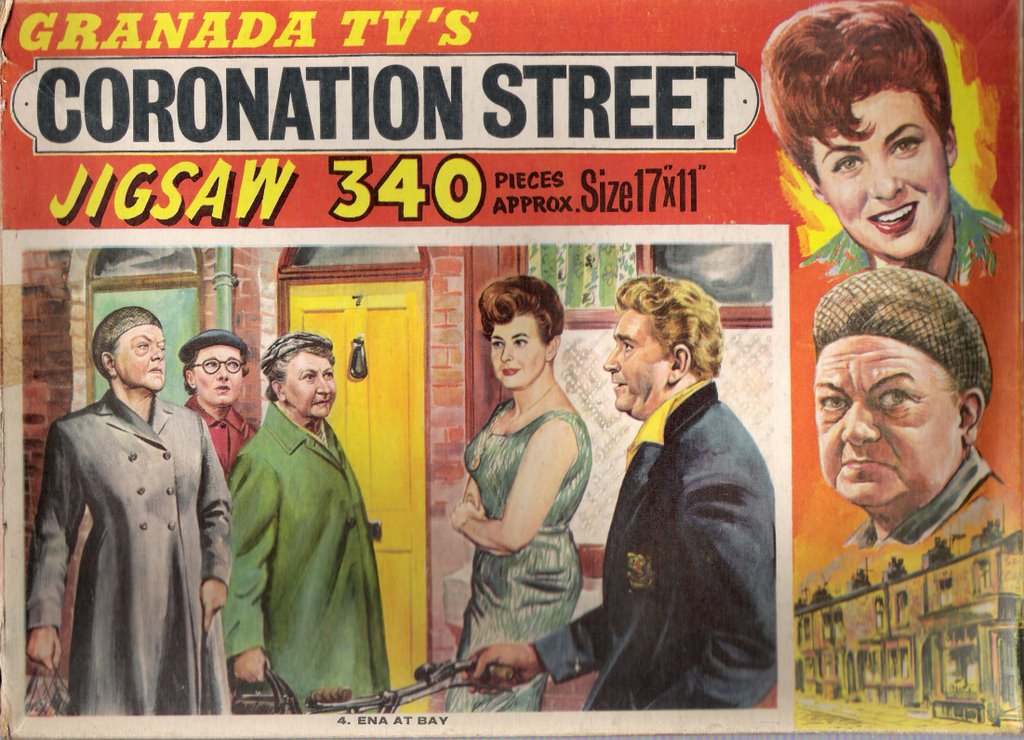
One of a series of jigsaw puzzles from c. 1963 featuring characters from Coronation Street. Note the street featured on the box, which is actually Archie Street, Ordsall - the original template for the Coronation Street architecture. English folklore has been greatly enriched by the addition of television soap opera characters like fearsome old dragon Ena Sharples and the glamorous and fiery Elsie Tanner.

The Street began on 9/12/1960, the creation of one Tony Warren, and continues to entertain a mass audience to this day.

The characters featured in this jigsaw have long departed. Ena Sharples (Violet Carson) left in 1980, and moved to Lytham St Anne's; Martha Longhurst (Lynne Carol) died in the snug of the Rovers Return in 1964; Minnie Caldwell (Margot Bryant) left to keep house for an old friend in 1976; Elsie Tanner (Pat Phoenix) left in 1984 to live in Portugal with an old flame; and Len Fairclough (Peter Adamson) died in a car crash in 1983.

Archie Street was demolished in 1971.