Showing posts with label 1970s. Show all posts

Monday, 3 April 2023

Coronation Street 1978: The Barlow Twins: RETCON! Twins Lose Two Years of their Lives!

We recently had an email here asking us about our assertion that a Corrie retcon occurred over the Barlow twins' age in 1978. The writer had read in a 50th Anniversary Book that the retcon trend set in in the 'cynical 1980s'.

Ooh, aye, luvvie - the cynical 1980s!

Well, this was in the totally non-cynical (giggle) 1970s. It was 1978. 

The Barlow twins' age retconning was actually put right in the 1980s - in 1986, when they celebrated their twenty-first birthday.

From the Sunday Mirror, December 10, 1978:

WHOOPS! The great minds who think up Coronation Street story-lines for Granada TV have been caught out - by Sunday Mirror readers.

Two of them have spotted a flaw in the otherwise scrupulously worked-out plot of the top-rated serial.

The flaw came to light after we invited readers last Sunday to send in their Street questions.

Both Mrs JE Godwin, of South Ockendon, Essex, and Mrs R Rowland of Wardley, Swinton, Lancs, asked this question:

Why does Granada TV insist that the Barlow twins, Peter and Susan, are almost fifteen when they were born on April 5th, 1965?

Both ladies remember the date well because Mrs Godwin had twin boys and Mrs Rowland a daughter around the same time.

Granada TV were happy to own up to a bit of "fiddling".

Planners changed the age of the twins to suit a story-line involving Peter Barlow and his O Levels.

However, they do hope to correct the situation in future.

As we mentioned, this turned out to be 1986. When Susan Barlow visited the Street in 1981, she seemed set to apply for a temporary job in a wine bar in London. She was too young, going by the 1965 birth year, so the 'tweaking' obviously remained until the twins' 21st birthday of 1986.

We actually knew a woman back then who wrote to Granada TV on the subject. The letter was replied to by the Street's archivist, Eric Rosser, who stated very firmly that he had voted against the "fiddling" - or retconning as we call it today.

Saturday, 7 March 2020

What If Coronation Street Was Archie Street? Part Five

As we cross Coronation Street to the 1989 development, let's pause for a minute and think about the inhabitants of Archie Street and Coronation Street. Any similarities? Well, sadly, the residents of Archie Street did not appear onscreen to entertain the nation twice weekly for decades, so it's hard to tell. And, judging by the comments of some of them way back then, Coronation Street was really not doing Archie Street justice at all, and they disliked the association and publicity.

But there was one similarity: Manchester United football player Eddie Colman, one of Busby's babes tragically killed in the Munich Air Disaster in 1958, lived in Archie Street. David Barlow, Ken's younger brother, also had a brief professional football career.

Eddie Colman, the sporting celebrity from Archie Street, died at the age of 21.

Frank Allaun, the MP for East Salford, was sometimes regarded as Coronation Street's MP, he was tireless in his praise for the show - and Archie Street was dubbed by some 'Coronarchie Street'!

Coronation Street creator Tony Warren with Frank Allaun on a visit to Archie Street in 1961.

Anyway, back to our walk round, and standing on the side of Coronation Street redeveloped by Maurice Jones in 1989, we take a trip back in time to 1960 to look at the situation then.

In those days, this side of the street was dominated by Elliston's Raincoat Factory and a woman with a mission - Mrs Ena Sharples of the Glad Tidings Mission Hall, next door to the factory, to be precise.

Detail from a Coronation Street Christmas card produced by Granada for cast members to send to fans in 1961. This particular card was from Doreen Keogh (Concepta Riley/Hewitt). The Street has single bays, the 'tin pot' structure of the Glad Tidings Mission Hall can be seen, and part of the raincoat factory.

The Mission Hall backed on to the Street and Ena's vestry entrance was there. The raincoat factory, which switched to funky PVC in the mid-1960s, was apparently a gloomy old Victorian building - but never wholly seen. We did get the odd glimpse, but the exterior's starring moment came when Christine Hardman climbed up onto the roof in a suicide attempt in 1962. We still didn't see much of the building, but a certain small area of the roof is now faithfully recorded.

The interior, of course, saw more action - including the introduction of one Miss Elizabeth Theresa Lynch in 1966.

The late 1960s saw the Mission Hall and the factory demolished and a row of horribly modernistic maisonettes built in their place. Gosh, weren't they ugly! And somehow they never quite keyed into the street and few residents were seen. Effie Spicer, an old acquaintance of Jack Walker, lived there briefly, as did Ena and the Barlow family.

But, in 1971, after Valerie Barlow electrocuted herself with a hairdryer and caused a fire at the maisonettes, they were demolished.

They were replaced by a community centre and a warehouse. The Glad Tidings Mission had dabbled in community work in its latter years, so the new community centre on the site was rather like 'out with the new, in with the old' - particularly when Ena became live-in caretaker there. It was a peculiar building, looking rather like a shed with gothic windows. And why did Ken Barlow and Karen Barnes, a young woman he assisted with her reading, emerge from Ena's flat when Ken saw her off the premises in 1979? Goodness alone knows. I'm sure Ena would not have been keen on them traipsing their way through. Then, in 1980, the front of the centre was rebuilt due to problems with the foundations, and looked rather more real.

The Street with its groovy, space age '60s maisonettes.

The warehouse suffered a disastrous fire in 1975, and was bought by Mike Baldwin the following year. It was a grim building, fit for purpose only. As Connie Clayton said in 1985: 'The view of that factory don't grow on me.' The factory, of course, boasted a sewing room, several offices, and a packing department which we never saw. Did it need a dedicated packing department - after all, it wasn't that big a concern? Search me, luvvie. Of course, in the 1980s, Acorn Antiques also had a packing department.

Coronation Street, circa 1985 - just before Alf Roberts had the Corner Shop modernised.

The 1980s, of course, were a time of change. The decade was hugely controversial - heaven or hell, darling? With all the shouting going on (which still goes on when the 1980s are discussed to this day) it's hard to tell. Maybe it was both, but it certainly left its mark on Coronation Street.

1989: A glimpse of what would become a charity shop, then the hairdressing salon. 

When Maurice Jones demolished the factory and community centre to make way for a spanking new development of houses, shops and industrial units, the 'dark side' of the Street finally moved into the modern day and the cheap-but-stylish development was a revolution.

You know, luvvie, from certain vantage points the development looked a bit like toy town. I mean, I wouldn't have fancied living there - although, like the old terrace, the area's strange magic worked to make the interiors bigger than the exteriors.

Now all that's solved (well, just about) with the move to the new exterior set.

Well, love, in't final part I'll give my final opinion on the Street's architectural oddities past and present. Tarah for now, cock. I'm poppin' round Ida's for a brew. With a bit of luck I might get a gipsy cream with it - but I won't hold me breath.

Flamin' Nora! They're well past their sell-by!

Part 6 is HERE

Monday, 2 March 2020

Coronation Street: Feminism, The Gay Creator, Misandry And Rita Fairclough The Liar...

The scriptwriter of a Coronation Street episode in the early 1990s had no qualms in rewriting history to make our Street favourite Rita Fairclough out to be a victim of an insensitive husband, while actually making Rita seem like a downright liar, touting for sympathy, to those of us who knew the plot.

Back in 1981, Rita suddenly discovered a strong maternal instinct. True, she had looked after Harry Bates's kids some years before, but streetwise Rita had always seemed quite happy without kids of her own, telling Mavis there would be no patter of tiny feet at No 9 after she married Len.

In 1980, when Rita walked out on Len, her concerns were for a 'decent' house and a dishwasher - not kids.

But in 1981 Rita babysat Nicky Tilsley, and suddenly went all broody. She told Len she wanted to adopt, and Len, at first stunned and incredulous, very quickly agreed. Then the couple found out they were too old, and fostered instead.

But in the early 1990s, Rita told Sally Webster that by the time Len had agreed on adoption, they were too old.

A huge difference.

Also in the 1990s, Bet Gilroy and Rita had a huge barney in the Kabin. Bet pointed out that it was Len's money that got her started. Rita stated: 'Len left me a tatty little shop!'. Yes. And money in the bank, a brand new house at No 7 Coronation Street, the builder's yard in Mawdsley Street...

We adored Rita, but the Street's scriptwriters and producers sometimes did her no favours at all. The watering down of this fabulous, feisty character in the 1980s and her subsequent victimhood at the behest of Alan Bradley dd not convince us. Rita simply did not suit that storyline. She had far too much pride to fling herself at Alan in the way she did, her tears of horror ('Just like Len!') when Alan punched somebody in the Rovers (she hadn't been averse to walloping people herself, including Len, in the good old days) and so on, partially destroyed one of the show's best ever characters and seemed to be taking chunks out of the Feminist Guide To Misandry rather than presenting real life.

Corrie making victimised heroines out of its female characters is farcical. The women are at their best when being strong, human and frequently awful, seeing the faults of their spouses and partners, not their own. Audrey telling Alma she'd married a 'big baby' in the 1990s was a classic example of this. Our beautiful Aud had been selfish, childish (locking herself in the loo in a sulk after she and Alf had been forced to move into the Corner Shop flat when the chain on the house they were hoping to buy collapsed) and generally a lazy shopaholic for years. And we loved her for it. The fact she could see none of her own faults made us love her more.

I have to say that many of Coronation Street's women are at their best when following the template laid down by the show's creator, Tony Warren, himself a gay man and not averse to a bit of camp.

Let's hear Mr Warren on the subject: 'I'd known all these queens [gay men with a penchant for camp] in the village. Some of their dialogue was too good not to use. I remember giving Elsie lines that they would say. When you think of some of the things she came out with, how many straight women have you heard say that?'

The original template - women talking like camp men. The genius - the late Mr Tony Warren.

The original scripts, with their apparently ordinary but slightly tweaked dialogue (witness Ena in the Corner Shop in 1960!), were very much this man's tribute to northern English femininity. But far more evocative of a witty evening in a gay pub with a number of camp men present than ordinary female conversation. The world was really not ready for a soap about gay men!

Coronation Street has become self consciously feminist - and as that ideology is now being questioned far and wide (men oppressed women - oh, really?!) is straying far from its roots and has been growing progressively worse since the 1970s (the Susi Hush era). Ideologies are not facts.

The Street went from being a lovely matriarchy (as many such streets are) to being the misandry mile. A great difference, relying on warped Feminist dogma to score points and create female victimhood.

So, Rita, love, don't tell lies, eh, chuck? Don't forget your marriage was under the microscope on our TV screens - we were there too - so it really doesn't wash.

For years, Feminism was not questioned. But now it is. Chivalry should not allow riding rough shod over facts and demonising an entire gender, and the facts about the vote - suffragettes bombing and harming working class, vote-less men with acid, the SCUM Manifesto, the Duluth Model and the horrors experienced by Erin Pizzey in the 1970s are being examined at long last. As are the true facts about the gender pay gap and the workplace death gap.

About time too.

So, pack it in, eh, Corrie?

The misandrist nonsense (often created by 'white knight' chivalrous men) still goes on and was one of the things which drove me away from the show many years ago.

Remember your roots.

Questioning Feminism? Heresy, eh? Misogynistic or not? Not. Read what Karen Straughan has to say on the subject and just how this hate ideology has infested every nook and cranny of our lives: 
https://antifeministpraxis.com/2017/03/31/feminism-was-never-not-rotten/


Thursday, 13 February 2020

What If Coronation Street Was Archie Street? Part Four

Well, luvs, we've covered a lot of ground, and now we find ourselves in the back ginnel running between Coronation Street and Mawdsley Street.

The back yards are tiny, poky affairs, with outside lavvies (once the only lavs in each household). Of course, they're not lavs anymore. But the Ogdens' at No 13 was operating as a second lav in 1980 (and probably well beyond). We're not sure about the rest.

The kitchens jut out into the yards and... well... back in the day they shared the Street magic of being much bigger on the inside than on the outside.

The kitchen windows were low-set (are they on the 21st century exterior set?), but indoors had kitchen sinks beneath them. From outside, they were pantry-sized cubby holes.

No 9, with its lean-to glass extension, was the only house to differ.

The Corrie back ginnel as it was on the 1982 to early 21st Century set.

Ken and Deirdre Barlow at Number 1 had a posh kitchen extension in the mid-1980s. This was downright peculiar at first.

The kitchen having expanded, exterior shots showed that the old back room window was now no longer. But it remained inside for ages - before the design team twigged and it was turned into an interior window, giving 'borrowed light' from the kitchen.

Deirdre, Ken and Tracy, embroiled in their late 1980s saga of brillo perms, shoulder pads, Wendy Crozier, and listening to Bros cassettes upstairs, noticed nothing odd of course.

Come on, Tracy luv, join in: 'You're a slave to fashion and your life is full of passion...'

The backyard dividing walls could be odd. Sometimes they moved. Elsie Tanner's yard might be quite large one week, with the yard wall by the Ogdens' back window, but another week the Ogdens' yard might be larger, with the wall by Elsie's back window. And so on down the terrace.

The real back ginnel between Archie Street and Clement Street was featured in the Coronation Street titles for a while back in the 1960s. The Corrie ginnel is cobbled. The Archie Street ginnel was flagged.

Coronation Street backs on to Mawdsley Street - once home to Len Fairclough and Martha Longhurst - and home to Len Fairclough's builder's yard for many years (although it wandered off briefly in a 1976 map of Weatherfield featured in the TV Times). It was in Mawdsley Street, at the congregational chapel, that Emily Nugent married Ernest Bishop in 1972.

Archie Street backed onto Clement Street, named after St Clement's Church, a longer street which ran across the junction from the side of the church.

Len's yard popped over to Balaclava Terrace in 1976 in an officially sanctioned map. And then popped back to Mawdsley Street. It made a nice break.

An old mystery from the back of the Street is the Rovers stairs, running up the back of the premises from 1960-1986. After the infamous fire of 1986, they changed direction during the rebuild. That's because the original route of the stairs was a bit impossible. They would have run straight past the back parlour window.

Also, the part of the Rovers building that juts out to join the strange viaduct... well, it's an amazingly narrow jut-out. In fact, to me, it looks like a wall with a door and an upper window in it. Bet Lynch would never have got down it, even if she'd pulled her chest right in. And as for Fred Gee and Betty Turpin! What possible use is it?

Even in the super-spacious Street of the 21st century, there's still no room at the inn in the Rovers extremity.

Now we've reached Rosamund Street, site of the modern (and frankly bizarre) viaduct arch. In the Archie Street universe, we've reached Cavendish Street. Across the road is St Clement's Church. Coronation Street once had a church opposite it - back in the days of the indoor exterior set. It was called St Mary's, but - from 1968 onwards - that was a thing of the past, replaced by an occasional glimpse of a wall with gates set in it, and, from 1982, by a building which quickly became the Graffiti Club, wine bar and disco.

Echoes of reality: The church opposite the corner of Coronation Street on the 1960s set. Martha, Albert and Ena queue up to get their hair done at Valerie's in the foreground.

Rosamund Street in those days, was, of course, a long, straight road - apparently one of Weatherfield's main arteries (though it never seemed very busy). From the show's earliest days we'd tended to hare off down Rosamund Street at times. A Rosamund Street shop was part of the Street's action for decades. From the days of Swindley's haberdashery and Gamma Garments to the days of Len Fairclough's shop, the Kabin, Rosamund Street was a must-see.

Rita Littlewood, of course, was at first employed as manageress at the Kabin, but later married Len thus becoming part owner, and, upon his death, owner. The Kabin gave us years of wonderful, cherished scenes of Rita and her assistant Mavis Riley.

'I'm telling you now, Rita, that pineapple thingie's giving me the creeps! I can feel its eyes on me!'
'Get a grip, Mavis! There's a lot stranger things round 'ere...'

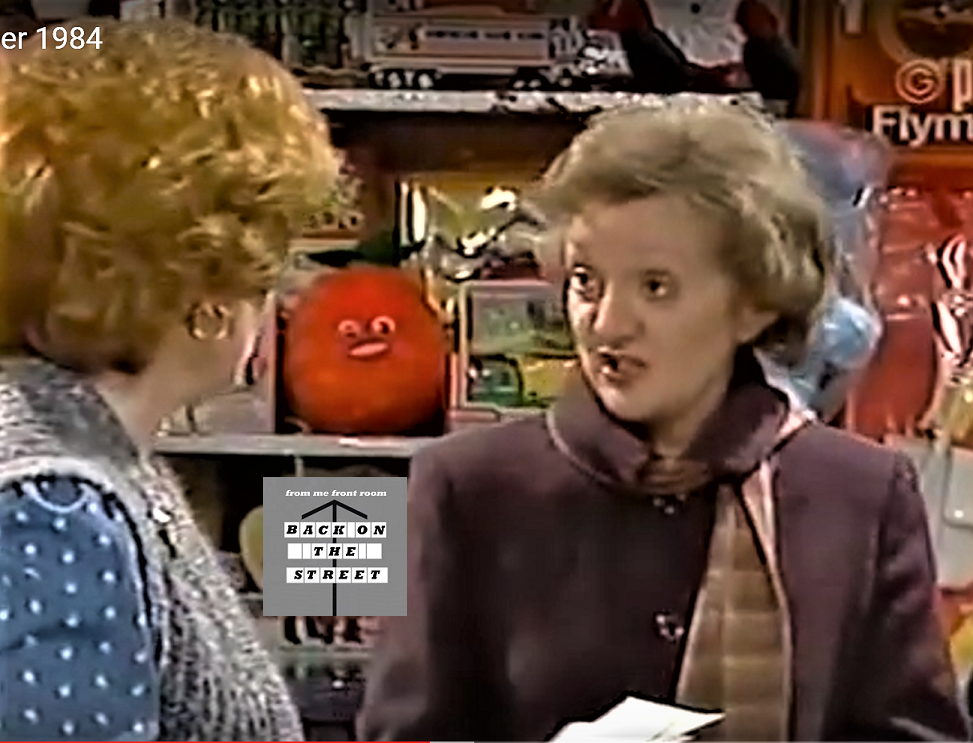
Next door, of course, baker Joe Dawson opened up a genteel little tea shop in 1978, causing the Kabin's café to close, and, in 1980, this genteel little emporium was bought by one Jim Sedgewick, who turned it into a rough and ready transport café.

In 1990, Rita sold the old Kabin and moved to a brand new one in Coronation Street. But Jim's Café continued to be featured. And here comes another mystery...

After a while, the old Kabin simply disappeared.

The doors to the Kabin and Jim's faced each other across a small, covered lobby.

The Kabin door remained for a while after Rita had decamped, seen from the interior of Jim's whenever somebody opened the door to enter or exit. But then, suddenly, without explanation, the old Kabin door disappeared, and was replaced by an advertising or community notice board. Jim's Café was suddenly at the end of a terrace of shops - and there was no sign of a covered lobby - or a shop next door where the old Kabin should have been - and no sign that part of the terrace had been demolished either.

Never mind, cock.

What a difference a decade makes! In 1984, it was Mavis, Rita and the pineapple thingie. In 1994, the old Kabin had vanished.

Next time I'll be takin' a look at the other side of the streets - Coronation and Archie - to delve more into't past and some of its oddities.

Anyway, I'm off to bingo and that new Pizza Hut in Esmerelda Street with Ida Clough tonight - so I'd better be makin' tracks. Should be a great night. You know worra laugh she is.


Part 5 is HERE

Monday, 1 July 2019

What If Coronation Street Was Archie Street? Part 2

So, luvs, welcome to Part Two of our little series on the differences between Coronation Street and its long demolished template, Archie Street in the Ordsall district of Salford.

Well, we often noticed the lack of chimneys. In Corrie, not Archie Street. This was obvious in longer shots of the exterior sets after the first set was moved outside in 1968, then recreated in brick in 1969 (backyards were added later). Coronation Street had no chimneys. So, how did Suzie Birchall lob a brick down one in a late 1970s episode? Lord alone knows. We only saw it in close-up, and afterwards it was gone forever. Coal fires were possible in the house interiors though, so I suppose nobody noticed the lack of the necessary up-above.

"Chimneys? Nay, lass, we didn't 'ave chimeys round 'ere in them days. We never noticed the lack
either. We didn't even 'ave whole roofs. AND the cobbles ran the wrong way. We just carried on. We were built of sterner stuff. You young 'uns don't know yer born..."

This strange state of affairs lasted until 1982, when suddenly Corrie had chimneys. And the graffiti littering certain walls, and general run-down appearance of the place, suddenly disappeared. And the house exteriors suddenly got bigger, and there was a building on Rosamund Street we'd never seen before - which became a disco and wine bar. We supposed it was all due to the fact that the 1980s were an expansive and upwardly mobile decade.

Archie Street didn't get bigger. It got demolished. The first families were moved out in 1968 and demolition followed in 1971. But Coronation Street had survived. And was booming.

Even in the new scheme of things, the Corrie exterior was still too small to accommodate what was supposedly inside.

In't '80s, the Street suddenly got chimneys, fully-structured houses, and even the cobbles ran the right way!

Next, we pause at Number 13, home to our beloved Stan and Hilda Ogden. Here lies the strange tale of the straightened wall.

Now, Stan and Hilda didn't ever have much to boast about. They weren't even 'on the phone' (landline, of course - no cell phones back then). Actually, to go off on a tandem, sorry, I mean at a tangent, this made them far more natural back street denizens of that era than most other Corrie residents. It wasn't until the 1980s that 50% of UK households were on the phone, and Coronation Street always seemed a bit too populated with phone subscribers compared to real life humble back street dwellers like me. In my street of twenty houses, only one person had a phone by 1981. Yep, by not having a phone, the Ogdens were being more true to back street life, as I and my true life neighbours were living it, than Elsie Tanner!

But their house was a typically twilight zone Corrie dwelling in other respects.

However, from 1976 onwards, the Ogdens had one thing to boast about.

And I'm not talking about Stan's canteen-sized serving hatch.

Nope. I'm talking about Hilda's murals or 'muriels' (1976-1978 and 1978-1988).

And a wall which flattened itself to accommodate them.

The Oggies had a contoured or stepped wall which miraculously flattened itself when Eddie flogged them the first scenic delight. I think the 'muriel' would have been even funnier with the contoured wall, but there you go. The Oggies' house was obviously very obliging. At times.

'Ee, Stan, I'll 'ave to 'ave a polite word with that wall before Eddie puts me muriel up...'

'Naice' Wendy Nightingale - the first of two wanton Wendys in the life of Ken Barlow - was far too polite to notice the scaffolding, plank, and cold, grey sky in the Oggies' hall in 1976.

Clopping on down to the Corner Shop, we discover several mysteries.

The Corner Shop resembled its Archie Street counterpart (the Daniel Clifton off-licence branch) in exterior appearance more than any other Corrie property. Particularly when it became obvious the Corrie houses had adjoining bay windows (sometimes, early on). The adjoining bays moved the Street away from the template design.

Elsie Tanner and Ena Sharples go hell for leather outside Elsie and Christine Hardman's adjoining bay windows in 1961. By the time of  Ida Barlow's funeral later that year, the windows were having a trial separation. They'd done it before, too.

Mouse-like Florrie Lindley revealed an unexpected brave side when she had the shop frontage drastically altered in the mid-1960s. The shop door was moved from the Viaduct Street corner onto the street itself. This was fine. Logical. Once again, the shop was a little small on the outside to accommodate what was within, but it was when you looked upstairs at the shop flat that the real problems began.

The flat's interior had too many windows and sometimes had its own kitchen and sometimes didn't. Bet didn't seem to have a kitchen and slummed it with Renee and Alf when it came to meals. But the kitchen was very evident at other times - particularly when Kevin and Sally lived there. And the flat was pleasantly lighted - by several windows which didn't exist outside. Where WERE those windows on the exterior set, some of us wondered? In fact, we were surprised when a bathroom window was suddenly revealed in October 1980 to accommodate a story about Tracy Langton getting locked in the lavatory. Where had it been all our lives?

Intrepid Alf Roberts to the rescue - up a ladder to coax the door key from Tracy Langton who had discovered a toilet at the Corner Shop - and locked herself in.

"We've gotta get outta 'ere, luv," - Kevin and Sally Webster are freaked out by the sudden realisation that the Corner Shop flat has too many windows.

In the next exciting episode, we look at a few more mysteries of the terrace, the viaduct, Rosamund Street and the other side of the streets (Archie and Coronation).

Now, I'm off to't pork butcher's before they close. I like to give my family a proper cooked meal every night - none o' yer tinned rubbish. You can ask anybody. Ask Ida Clough.


Part 3 is HERE.

Sunday, 5 May 2019

What If Coronation Street Was Archie Street? Part 1

Well, luvs, had a long break and things are all right here. Well, Ida's bought herself a new pair of neon pink fluffy mules, but apart from that. Talk about mutton dressed up as lamb...

Anyway, I was thinking about Corrie and its origins the other night and the long-gone template for the terrace, Archie Street, in the Ordsall district of Salford.

Of course, the terrace selected was just a template, and while Corrie used the actual Archie Street in its opening titles for a while, things soon began to alter.

Let's take a look (wi' a dash of humour, luvvie, cos we could all do wi' some), at how Coronation Street began and its original differences from Archie Street, then look at how things evolved...

For a start, Archie Street had no corner pub. Nope. Not a single one. So, you'll just have to go to't Flyin' Horse, won't yer? Or nip down to the corner off-licence. No Corner Shop, but an off-licence, part of the Daniel Clifton chain. Not sure if Florrie Lindley would've fancied it, but then she used to work in a pub...

The Archie Street terrace also had more houses and single bay windows - which were represented in Coronation Street for a time. The trouble was, in erecting a studio frontage, space was at a premium, so the bays became joined in Corrie Land.

With no Rovers in Archie Street, we dispensed with some mysteries, of course. Like how the Rovers toilets led into Albert Tatlock's house (even the addition of a tiny entry on the 1982 set didn't really alleviate the embarrassment) - and why there was a huge Select with a stage which would have stretched right across Rosamund Street, the same being true for the back parlour and kitchen.

Eee 'eck, Mrs Walker!

"My dear! The things I have suffered!"

The great Rovers 1940s Show in the 1970s - with Norma Ford, Bet Lynch and Betty Turpin giving it their all in the mysterious Select. Look out, girls there's a bus coming!

At Mr Tatlock's, mysteries were fewer, though we did wonder - as we did with all the houses - why they were so much bigger on the inside than the out. The hall wall beside the front door was sometimes wider than at others (as with the rest of the houses) and Albert once sprouted a door at the top of his stairs which would have led directly into Emily Bishop's (REALLY, MR TATLOCK!), but never mind.

Unlike Archie Street, the houses in Coronation Street had hallways. In Archie Street, the front door opened directly into the front room. The stairs were accessible from the back room (kitchen with range) and ran up the middle of the house. Just how you got the stairs and hallway into the Corrie frontages was a bit of a mystery. But then the place was teeming with them.

Like that dreadful time the lorry crashed into the Rovers in 1979 and Emily's house temporarily grew a new wall which blocked off her stairs. Thank goodness there was an outside lavvy as well.

As soon as you turned your back, strange things happened in the Corrie houses.

But a day or two later things were back to normal. And nobody had noticed a darned thing!

Mind you, Emily's upper floor was obviously not a very hospitable place. Some writer once said there was no place colder than an English bedroom, and Emily and Ernest's was probably the very worst. When Minnie Caldwell's house went up for sale in 1976, we were treated to a view of the Bishops' bedroom window, curtains gently fluttering, and grey sky and scaffolding behind them. BRRR!!

Talking of upstairs, Corrie houses had incredibly high ceilings back in the 1960s, '70s and '80s. So high, you never saw them - just an expanse of wall above the picture rail. Very odd as that didn't match the exteriors at all, with the bedroom windows lying low over the bay windows...

Archie Street never had a house with a collapsing frontage. But Coronation Street did. Number 7 succumbed to that fate in 1965. Looking at the ruined frontage, it's odd that it seems to have widened at this point. And the houses either side have obviously made way for its expansion. The area was made safe and a bench was placed in the space. Very odd. That's all there was space for. As one letter-writer to a national newspaper wrote in 1981, when Len Fairclough was planning to build a new house there: 'The only people that could live there would be Marti Caine and the Thin Man!'

Look how far the front door is from the bay window!

Well, ducks, I'll be off now. That's it for the first part. There's another on't way. Just to say, all this is written with great affection as I loved Corrie back in its first three decades. And for all modern day fans - well mysteries like the sudden arch near the Rovers and the fact that Rosamund Street is no longer a long road running on a straight course through Weatherfield are nowt new.

Wonder what the residents of Archie Street would have said if their environs had been subject to the same Twilight Zone madness as Corrie's?

Part 2 is HERE.

Sunday, 7 September 2014

Worst Story-Lines... The 1970s... Lorry Crash...


A while ago we published a post about our worst story-line of the 1980s - Rita's amnesia of 1989 won the prize. For our next decade, the 1970s, there were several highly stinky contenders, but we decided that we'd pluck the lorry crash out of early 1979. It was a blockbuster that didn't work in our opinion, and looks laughable in retrospect.

Why?

Well, consider...

Firstly, Tracy is kidnapped. Conveniently, a young girl Deirdre was in maternity hospital with turns up not long before the crash... and moments before the crash, kidnaps Tracy from outside the Rovers. Would any sensible mother had left her little child outside a pub (or anywhere come to that?) anyway? No... it was incredible. TOO incredible!

Deirdre, it wasn't even safe to leave Christopher Hewitt outside Gamma Garments in 1962. What the 'eck do yer think yer playin' at, luv?!

And then there was all the drama of Deirdre threatening to jump in the canal and Alf Roberts's coma and mental health problems - so badly done. So soon forgotten.

And on top of all that, there were the victims of the crash with minor cuts and bruises - Len and Betty spring to mind - whose injuries seemed to disappear in an absurdly short amount of time.

We can forgive things like a fireman casting a shadow over the factory as he tried to get into the Rovers through a devastated window after the crash - we all know how the show was produced in those days, and actors casting shadows on "scenery" was accepted.

But as a piece of drama, the lorry crash simply does not stand the test of time. And it wasn't particularly great even in the 1970s.


Saturday, 2 August 2014

Ena Sharples - 10th Anniversary Portrait

This lovely portrait of Violet Carson, in character as Ena Sharples, was one of a series commissioned by the TV Times magazine to celebrate Coronation Street's 10th anniversary in 1970. Other characters were featured over the ensuing weeks.

Ten years is a long time, and for Ena they had not been easy: she had faced the sad loss of her daughter Vera Lomax and her longtime friend and Rovers Snug companion Martha Longhurst; she had been buried in rubble when a train crashed off the viaduct; she had almost been killed in a coach crash; she had fought many battles with the fiery Elsie Tanner; her vestry home at the Glad Tidings Mission Hall had been vandalised and later demolished...

In the opening years, Ena was rather a scary figure and not terribly pleasant to have around (well, not for the other residents of the Street, but a WOW for viewers!). However, as the 1960s had continued, she had mellowed and, although still capable of epic battle, had become a much-loved and respected figure, a soap legend.

Violet Carson commented in 1970:

"Ena's still the battleaxe she was ten years ago, but she does have a heart of gold, and the mellow side of Ena has come out much more lately. Over the years I have tried not to let Ena's character overwhelm me. I've done my best to keep Ena and me well apart. Otherwise, by now, she would have taken me over."

Sunday, 1 September 2013

The Once Around Weatherfield Challenge - Part 1 - THE WINNER!


 Gabrielle Daye - 1939 Spotlight entry.

Absolutely chuffed to little mint balls with this response to my first Once Around Weatherfield Challenge. This is a new feature where I pick a bit-part or recurring character from the Street's past, stick a photo of him/her on here, and ask you lot to tell me about the character and the performer. The first chosen was the marvellous Beattie Pearson, Albert Tatlock's mean and prickly daughter (played by Gabrielle Daye) and the entry to the Challenge I received below has bowled me over because it's so insightful and detailed. I never expected owt like that! So chuffed am I, I'm going to award a special prize - an Alfred Roberts Corner Shop mug from 1985 to the winner, SUE BENNETT, and to Sue - I say CONGRATULATIONS AND MANY THANKS! I received two other entries - many thanks to Colin and Pat for those. Please keep trying! There'll be more Once Around Weatherfield challenges (and prizes!) soon.

And, without further ado (I've got to fix a hole in't cludgie roof this afternoon), here's Sue's biography of Mrs Beattie Pearson and actress Gabrielle Daye!

Regarding your Once Round Weatherfield challenge, the answer is actress Gabrielle Daye, who played Albert Tatlock's daughter, Beattie Pearson, in the Street as a recurring (occasional) character from 1961 to 1984.

Beattie took after her old Pop in that she was mean with the brass, but Albert had a kindness and generosity of spirit under his crusty facade that was not so obvious in his daughter. She was married to Norman, who, in rare appearances, seemed to be a bit under her thumb. Early on, it was stated that Norman and Beattie had children, but this seemed to be rewritten very quickly. 

Albert was critical of Beattie, and although he stayed with her and Norman on occasion, was actually much closer to Ken Barlow, who had married his niece Valerie in 1961. Even after Valerie's death in 1971, Albert stayed close to Ken, who spent long spells living with him.

Albert was also close to Ken and Val's twins, Peter and Susan, his great-nephew and niece, who were born in 1965. He often visited them in Glasgow and was delighted on the rare occasions they visited the Street.

A chance remark of Beattie's in the '80's revealed that she charged her father a bit "for his keep" when he stayed with her.

When Ken married Deirdre in 1981, Beattie was concerned that she would be left to look after her father and made waves. She was highly relieved when the Barlows finally opted to continue living with Albert.

As Albert grew older, Beattie became concerned about her inheritance, No 1 Coronation Street. As she said in the early 1980's, it was the house she had been "fetched up in", and she faked some kind of sentimental attachment to it - which was a thin cover for her concern for the bricks and mortar value of the place. After Ken married Dierdre Langton and Albert offered them the house, Beattie was furious and stuck her nose in, creating bad feeling. In the end Albert accepted payment for the house from Ken, though less than its market value. Beattie reproached Ken about that, but Ken told her it was all Albert would accept. Beattie remained concerned about her inheritance - fearing that Albert would spend the money before he died and she'd get nothing.

Albert died while staying with Beattie and Norman in May 1984. Beattie redeemed herself slightly by presenting Ken with his Military Medal.

Gabrielle Daye did not appear in Coronation Street after 1984. The last mention of Beattie Pearson I recall came in December 1988, when the Barlows were going to pay her a visit, which indicated they had stayed in touch.

Born in 1911, Gabrielle Daye was an accomplished actress who appeared in numerous films, TV and theatre roles. Her TV work dates back to the genre's early years - the 1940s. She died in 2005.


Monday, 23 April 2012

Betty, The Rovers, Annie Walker's Will and The Barlow Twins...

  Annie, 1978: What she could have been saying...


"Of course, dear, the Barlow twins were born in April 1965, and next year they'll be turning fifteen. It really doesn't seem possible..."

Fiona has written:

I'm shocked that Coronation Street has tweaked the past with this terrible story about Annie leaving Betty the Rovers tenancy in her will. She left the pub and retired in 1983! This sort of tweaking would never have happened in the show's golden era - the 1970's.

Oh dear... I don't know how to tell you this, but this sort of tweaking first happened in the 1970s! The age of the Barlow twins was altered in 1978. Peter Barlow wanted to join the Navy and so his age was advanced by a year or two to make him almost old enough. Don't worry, the 1980s rectified the situation with Peter and Susan celebrating their joint twenty-first birthdays in 1986. The trend was picked up again in the 1990s when the age of Mike Baldwin's son was tweaked.

As for Annie and Bet, if Annie's will was an old one, written before she left the Rovers, I think she would have tried to pass the tenancy to her son, Billy. Also, if you watch the episodes concerned, you'll discover that Annie retired in 1984, not 1983.

Tuesday, 22 November 2011

What If... Coronation Street had 21st Century Style Story-lines In The '60s, '70s and '80s?

"That new couple from Mawdsley Street seem nice. She works in't kitchens at Imperial Hotel. He's a dry cleaner by day, serial killer by night."

Imagine if 21st Century-style Corrie story-lines had run rampant in the show's early years, wreaking a trail of explosions, serial killers, dark secrets and ghostly visitations across the first three decades.

Would viewers have switched off in droves, or been desperate for more? Here's how a few TV listing magazine synopsis for our favourite soap may have looked in the 1960s, 1970s and 1980s:


1960s:

Myra Booth's marriage is in trouble. She decides to murder Jerry - and the pot dog on the mantelpiece may be the perfect weapon.

Len murders Nellie and says she has run off with the insurance man.

Florrie Lindley has a nervous breakdown and blows up the Corner Shop.

Jack Walker continues to psychologically abuse Annie.

Stan suspects that Alan, Elsie's new boyfriend, is the serial killer.

Evil young builder Ray Langton meets a nasty end when Lucille Hewitt gets on his case.

The Vestry is devastated by a huge explosion. 


1970s:

Shock for Emily...

A power cut is the perfect time for a serial killer to strike...


Pulled from the flaming rubble of her maisonette, a dying Valerie Barlow confesses to Emily Bishop that Ernest is the father of the twins.

Renee Bradshaw admits that Suzie Birchall is her long-lost daughter.

Sick to the back teeth of men, Bet decides to kill Stan Ogden. She goes to prison, but is released quickly on a technicality, and returns to the Street to continue her reign of nastiness.

It's not snowing anywhere else in England, but the Street has a white Christmas.

Steve Fisher reveals his dark side (typical man!).

A flying duck ornament becomes a murder weapon.

Where was Ken when the murders took place?

Rita is taken hostage at the Kabin.


1980s:

Eeek - Mavis turns.

Deranged Fred Gee drives Annie Walker into the canal.

As the factory blows up, Mavis murders Derek and Victor, and decides to use the explosion to cover her actions.

Curly buys a gun.

The Claytons beat a hasty retreat before Connie's terrifying secrets can be revealed...

Nasty Alan Bradley comes unstuck when his business is blown up by a deranged ex-girlfriend.

Hilda is comforted by a visit from Stan's ghost.

As Percy tries to find out who sat on his Christmas pudding, he begins to suspect that it might have been a serial killer.

Driven mad by Corner Shop assistant Sally Webster's nasal twang and smug ways, Alf Roberts picks up a tin of pineapple chunks and...

Tuesday, 22 February 2011

Name That Cliffhanger 2 - The Answer!

Mavis Riley (Thelma Barlow) thought that Fred Gee (Fred Feast) was a very nice man. Rita Littlewood (Barbara Knox) was quite unmoved.

Thanks so much to those participated in our latest Name That Cliffhanger challenge. Only one right answer this time - and congratulations to Coronation Street Corner , who wrote:

Am I right in saying that she pretended he was her boyfriend because Fred Gee was pestering her to go out with him - she kissed him when Fred came to the shop to check up on her. What would be interesting if you could evaluate the Fred/Rita relationship in a blog post. Fred was one of many that held a torch for our Rita!

Absolutely correct answer, and an interesting idea for a future blog post. Thank you!

Anonymous wrote:

Had Rita been drinking? Was she not responsible for her own actions?

Well, knowing how our Reet liked to nip in The Rovers at lunchtimes, she probably had BEEN drinking, but that didn't contribute to her actions in this case!

Greg wrote:

1976 - the year before Rita married Len - so I wonder if she was kissing Derek to make Len jealous? Mavis was probably in on it.

Interesting scenario, Greg, but not the right one!

Cerys wrote:

Mavis was sick of Derek and asked Rita to take him off her hands. However, Rita's overtures made Derek realise that he loved Mavis.

Another interesting scenario - have you ever thought about taking up soap scriptwriting?!

The full, unexpurgated truth, is below.

At that time in 1976, Fred Gee was new to the permanent cast, and the lazy, randy, ogling Fred of the late 1970s and early 1980s had yet to emerge.

This was Fred's first venture into the romantic arena since losing his wife, Edna, in the warehouse fire the previous year.

He was completely smitten by Rita, took her a pot plant ("Keep blooming," he told her), and invited her to a big band concert.

Rita was horrified and took the coward's way out - telling Fred she already had a boyfriend.

Fred, however, did not give up, and called at The Kabin just to make sure Rita's sweetheart turned up for their date, ready to whisk her off to the big band concert if not.

Derek's arrival at that point, with a message for Mavis, was a gift from the gods for Rita. Fred didn't know him, and she swooped on him, giving him a big kiss and greeting him as her boyfriend.

Fred was crestfallen, telling Derek he was a lucky man - and to look after Rita.

Rita couldn't resist teasing Derek after Fred had left the shop, with her "just ask and it shall be yours!" comment.

Of course, it all came out - and Mavis was furious, telling Rita she couldn't keep her hands off any thing in trousers. She also gave Derek his marching orders.

Rita managed to win Mavis round, and engineered a meeting between her and Derek in The Rovers. So, the relationship which would culminate in marriage in 1988 was back on track.

Meanwhile, Fred was hurt to discover the truth about Rita's fella, and told her there had been no need to make a fool of him.

And Rita was left feeling rather shabby.