Showing posts with label Rosamund Street. Show all posts

Thursday, 12 March 2020

What If Coronation Street Was Archie Street? Part Six

Well, chuck, we've reached the final part of our little series comparing Coronation Street to its rough-template-real-life-counterpart Archie Street, which once stood in the Ordsall district of Salford. And as we stand outside Maurice Jones's posh 1989 Coronation Street development, what was on that side of Archie Street? More terraced houses, of a slightly different design, and a brick wall is the answer.

When Archie Street faced the bulldozers in 1971, Granada Television issued a press statement entitled THE BULLDOZERS FOR ENA? and Bernard Youens and Jean Alexander, our wonderful Stan and Hilda Ogden, visited the derelict street for a photo session.

The Ogdens survey the non-template side of Archie Street in 1971. Note the bay windows there had brick surrounds.

For years, it was put about - and Granada participated in this - that Archie Street had been replaced by high rise blocks, but it hadn't - simply by modern housing. St Clement's Church remained as a convenient orientation point when tracing the site. Just to confuse those not-in-the-know there's now another Archie Street in the district!

Coronation Street differs from Archie Street in that it is not real, and when I said a little while back that we should embrace some of the oddities thrown up by its architecture and changing environs over the years, I meant it. Since the Street was born almost sixty years ago, TV production has altered a very great deal. Hurriedly assembling sets back in the day led to occasional brow-creasers like Emily Bishop's back door leading into Albert Tatlock's yard on at least one occasion in the 1970s, and the cramped nature of the studio meant the frontages had to be tiny in the 1960s. So, Albert had to put up with having the Rovers loos in his house.

When the Street moved outside, a lack of chimneys and glimpses of interior scaffolding and interior grey sky were inevitable. But think about the improvement from the old studio set! It didn't solve Albert's problem though.

The old days - far too small, no chimneys and the Rovers loos are in Albert's house. "Funny old boozer this, in't it, Mrs Walker?!"

In 1982, we got to see Rosamund Street in a different light - no church opposite the street corner, as in the studio days, or high wall with gates in it - but the building which became the Graffiti Club. Once again, highly odd when viewed as reality but a major leap forward for the Street - as were chimney pots and a properly covered terraced.

Not to mention the size upgrade. Real size? No, as Jean Alexander said at the time, 'more real size.'

The 1980s.

And, in 1989, came the modern development on the community centre and factory site - bringing us the likes of '80s kids Des and Steph Barnes in February 1990.

The only thing I've ever really disliked is the strange Rosamund Street arch, which appeared at the turn of the 21st century. I've never seen anything like it in real life, but I can  imagine the production team were eager to block out the view of the Granada Studios - and having the Rosamund Street view beyond the arch was inspired.

With the latest set, we have another size upgrade and Rosamund Street is no longer a straight road. The Street's production team in 1960, unaware that the show would run and run, set an impossible task for the future: how on earth could you feature a busy main road? So, Rosamund Street became less busy, and with the opportunity to slot in more shops and a more realistic look for the latest set, I can imagine the temptation to alter the course of the road was irresistible.

Number 1 and number 3 Coronation Street. There's now room for hanging baskets outside - and the width of the halls can realistically accommodate stairs and the living room doorway inside.

I think the new Street looks a little too big in some ways - the houses more cottagey than Victorian/Edwardian urban terrace. The bay windows look positively palatial, but they make more logical sense. Again, in real life, I've never seen a street with neighbouring bay windows bolted together quite the way they are in Coronation Street. But that was born of necessity from lack of studio space back in 1960 and now the windows are at least large enough to have a properly sized room behind them.

The back of the Rovers could have been sorted out a bit better, and would there really be so many businesses in Victoria Street? I always imagined the Street nestling amongst other grotty, grey back streets off a main road, not in a funky area like that.

Two upstairs windows for the Rovers frontage instead of one makes perfect sense as the pub exterior was never big enough to accommodate the interior. The back, however, is rubbish.

But the pressure continues to produce more episodes and the new set reflects that. More stories and different settings are needed. The programme eats them up at a rapid rate.

It's all a far cry from the little girls playing outside the Corner Shop on the old studio exterior set at the start of episode one, and the days when the inspiration for the architecture became known as Coronarchie Street.

Roll end credits...


Thursday, 13 February 2020

What If Coronation Street Was Archie Street? Part Four

Well, luvs, we've covered a lot of ground, and now we find ourselves in the back ginnel running between Coronation Street and Mawdsley Street.

The back yards are tiny, poky affairs, with outside lavvies (once the only lavs in each household). Of course, they're not lavs anymore. But the Ogdens' at No 13 was operating as a second lav in 1980 (and probably well beyond). We're not sure about the rest.

The kitchens jut out into the yards and... well... back in the day they shared the Street magic of being much bigger on the inside than on the outside.

The kitchen windows were low-set (are they on the 21st century exterior set?), but indoors had kitchen sinks beneath them. From outside, they were pantry-sized cubby holes.

No 9, with its lean-to glass extension, was the only house to differ.

The Corrie back ginnel as it was on the 1982 to early 21st Century set.

Ken and Deirdre Barlow at Number 1 had a posh kitchen extension in the mid-1980s. This was downright peculiar at first.

The kitchen having expanded, exterior shots showed that the old back room window was now no longer. But it remained inside for ages - before the design team twigged and it was turned into an interior window, giving 'borrowed light' from the kitchen.

Deirdre, Ken and Tracy, embroiled in their late 1980s saga of brillo perms, shoulder pads, Wendy Crozier, and listening to Bros cassettes upstairs, noticed nothing odd of course.

Come on, Tracy luv, join in: 'You're a slave to fashion and your life is full of passion...'

The backyard dividing walls could be odd. Sometimes they moved. Elsie Tanner's yard might be quite large one week, with the yard wall by the Ogdens' back window, but another week the Ogdens' yard might be larger, with the wall by Elsie's back window. And so on down the terrace.

The real back ginnel between Archie Street and Clement Street was featured in the Coronation Street titles for a while back in the 1960s. The Corrie ginnel is cobbled. The Archie Street ginnel was flagged.

Coronation Street backs on to Mawdsley Street - once home to Len Fairclough and Martha Longhurst - and home to Len Fairclough's builder's yard for many years (although it wandered off briefly in a 1976 map of Weatherfield featured in the TV Times). It was in Mawdsley Street, at the congregational chapel, that Emily Nugent married Ernest Bishop in 1972.

Archie Street backed onto Clement Street, named after St Clement's Church, a longer street which ran across the junction from the side of the church.

Len's yard popped over to Balaclava Terrace in 1976 in an officially sanctioned map. And then popped back to Mawdsley Street. It made a nice break.

An old mystery from the back of the Street is the Rovers stairs, running up the back of the premises from 1960-1986. After the infamous fire of 1986, they changed direction during the rebuild. That's because the original route of the stairs was a bit impossible. They would have run straight past the back parlour window.

Also, the part of the Rovers building that juts out to join the strange viaduct... well, it's an amazingly narrow jut-out. In fact, to me, it looks like a wall with a door and an upper window in it. Bet Lynch would never have got down it, even if she'd pulled her chest right in. And as for Fred Gee and Betty Turpin! What possible use is it?

Even in the super-spacious Street of the 21st century, there's still no room at the inn in the Rovers extremity.

Now we've reached Rosamund Street, site of the modern (and frankly bizarre) viaduct arch. In the Archie Street universe, we've reached Cavendish Street. Across the road is St Clement's Church. Coronation Street once had a church opposite it - back in the days of the indoor exterior set. It was called St Mary's, but - from 1968 onwards - that was a thing of the past, replaced by an occasional glimpse of a wall with gates set in it, and, from 1982, by a building which quickly became the Graffiti Club, wine bar and disco.

Echoes of reality: The church opposite the corner of Coronation Street on the 1960s set. Martha, Albert and Ena queue up to get their hair done at Valerie's in the foreground.

Rosamund Street in those days, was, of course, a long, straight road - apparently one of Weatherfield's main arteries (though it never seemed very busy). From the show's earliest days we'd tended to hare off down Rosamund Street at times. A Rosamund Street shop was part of the Street's action for decades. From the days of Swindley's haberdashery and Gamma Garments to the days of Len Fairclough's shop, the Kabin, Rosamund Street was a must-see.

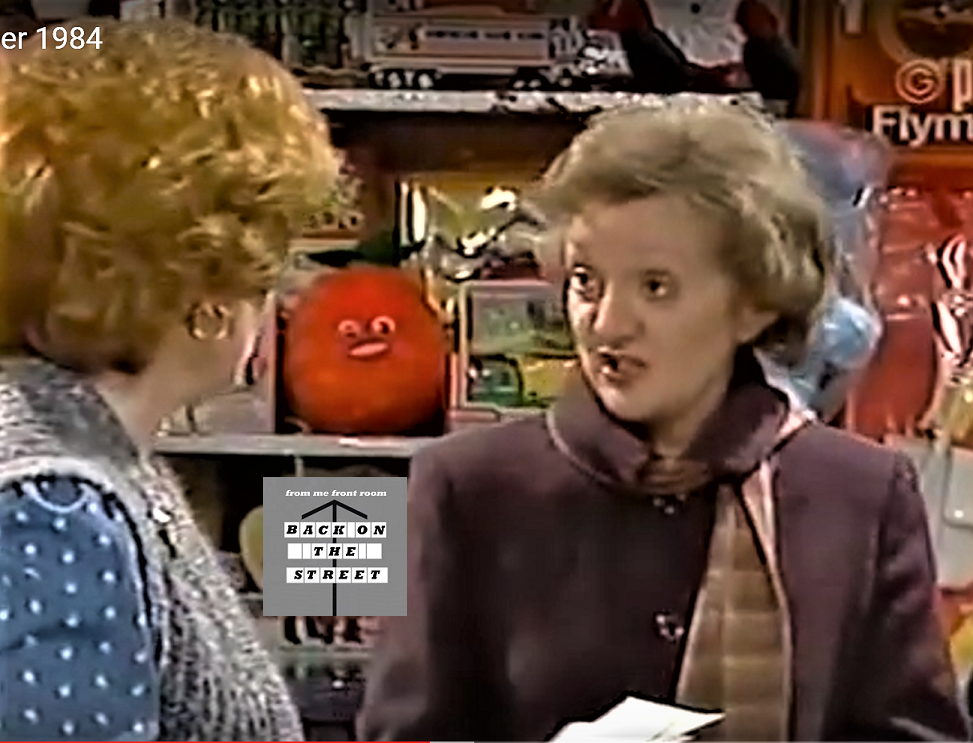
Rita Littlewood, of course, was at first employed as manageress at the Kabin, but later married Len thus becoming part owner, and, upon his death, owner. The Kabin gave us years of wonderful, cherished scenes of Rita and her assistant Mavis Riley.

'I'm telling you now, Rita, that pineapple thingie's giving me the creeps! I can feel its eyes on me!'
'Get a grip, Mavis! There's a lot stranger things round 'ere...'

Next door, of course, baker Joe Dawson opened up a genteel little tea shop in 1978, causing the Kabin's café to close, and, in 1980, this genteel little emporium was bought by one Jim Sedgewick, who turned it into a rough and ready transport café.

In 1990, Rita sold the old Kabin and moved to a brand new one in Coronation Street. But Jim's Café continued to be featured. And here comes another mystery...

After a while, the old Kabin simply disappeared.

The doors to the Kabin and Jim's faced each other across a small, covered lobby.

The Kabin door remained for a while after Rita had decamped, seen from the interior of Jim's whenever somebody opened the door to enter or exit. But then, suddenly, without explanation, the old Kabin door disappeared, and was replaced by an advertising or community notice board. Jim's Café was suddenly at the end of a terrace of shops - and there was no sign of a covered lobby - or a shop next door where the old Kabin should have been - and no sign that part of the terrace had been demolished either.

Never mind, cock.

What a difference a decade makes! In 1984, it was Mavis, Rita and the pineapple thingie. In 1994, the old Kabin had vanished.

Next time I'll be takin' a look at the other side of the streets - Coronation and Archie - to delve more into't past and some of its oddities.

Anyway, I'm off to bingo and that new Pizza Hut in Esmerelda Street with Ida Clough tonight - so I'd better be makin' tracks. Should be a great night. You know worra laugh she is.


Part 5 is HERE

Tuesday, 4 February 2020

What If Coronation Street Was Archie Street? Part Three

So, having clattered up the Coronation Street and Archie Street terraces, we find ourselves at the side of the buildings. Next to us is Coronation Street's Viaduct Street. Of course, the viaduct looms. In the Archie Street universe we're on Taylorson Street, standing by the front door to the off-licence living accommodation. The Corrie Corner Shop has a side door, too. It provides access to the flat above the shop.

No viaduct ever loomed over Archie Street. It was a bit loomed over by St Clement's Church at the other end of the road from the off-licence, and certain perspectives allowed the Ordsall Board School (local education board, not boarding) to loom a bit too. Must have been pleasant for the local kiddies out playing. Nice reminder of the joys awaiting them.

The viaduct has seen a lot of changes, of course. I don't recall the days of the Viaduct Sporting Club, but it was once there, and of course a train came off it in 1967 and a tram years later, and Deirdre Langton was 'molested' there and Tommy Deakin and his donkey hung out there and two robbers, out to loot the corner shop off-licence, watched till the coast  was clear there and Ena Sharples and Lucille Hewitt sang a duet there... oooh, all sorts.

But it was definitely subject to change. In the early 1960s a low wall ran across the street, dividing it from the viaduct, and in 1968 the whole thing looked rather different - definitely seedier, and in 1982 the whole thing looked rather different again (and better kept). It also sprouted a high wall and a fancy tower behind it.

Eee, luv, didn't it all look lovely in't 1980s? Real upwardly mobile.

I had suspicions in the 1980s that the viaduct had been snipped at both ends. Several views from the backyards revealed the structure suddenly ended, distinctly unsafe for trains, and when the new development was built in 1989, the fact that the other end was similarly snipped became painfully evident. Fortunately, since then, CGI has come to the rescue, allowing the viaduct to deposit a tram in the corner shop.

1989: in the stress of being interviewed by the local pigs while he's on the job, Alan Bradley can be forgiven for not noticing the snipped viaduct.

Residents of Archie Street might have found their surroundings faintly potty if they'd lived in Coronation Street, but our old pals in Weatherfield carried on regardless.

Another snipped viaduct arch now straddles Rosamund Street, of course. It arrived out of nowhere sometime around the turn of the century, and is almost bolted onto the side of the Rovers Return. Now, it's no use fans arguing that Maggie Clegg mentioned it in 1972 or some-such and that it's always been there. Because it ain't. Numerous views along the side of the Rovers over the years have revealed the lack, as have officially sanctioned artists' representations of Weatherfield. Up until a few years ago, Rosamund Street was revealed, stretching away into the distance, through the arch. But suddenly that changed and Rosamund Street is no longer a long straight road running through the town, as it was for over fifty years.

Don't fight the weirdness, luvvies - embrace it.

Like the course of true love, the course of Rosamund Street doesn't run smooth. Like the course of true love, it's subject to sudden, inexplicable change.

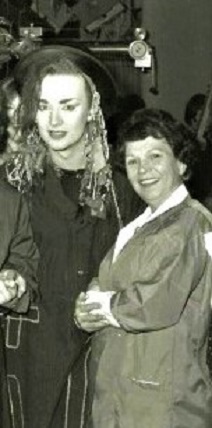
Well, luvs, time I were off. More coming soon, when we'll 'ave a poke round in the backyards. Boy George's opening the new extension at the Co-op today and Ida Clough's gone to get her picture took, so I'm right mithered. Mr Baldwin's been screaming blue murder.

Look at 'im - flaming disgrace!

Part 4 is HERE