Monday, 2 March 2020

Coronation Street: Feminism, The Gay Creator, Misandry And Rita Fairclough The Liar...

The scriptwriter of a Coronation Street episode in the early 1990s had no qualms in rewriting history to make our Street favourite Rita Fairclough out to be a victim of an insensitive husband, while actually making Rita seem like a downright liar, touting for sympathy, to those of us who knew the plot.

Back in 1981, Rita suddenly discovered a strong maternal instinct. True, she had looked after Harry Bates's kids some years before, but streetwise Rita had always seemed quite happy without kids of her own, telling Mavis there would be no patter of tiny feet at No 9 after she married Len.

In 1980, when Rita walked out on Len, her concerns were for a 'decent' house and a dishwasher - not kids.

But in 1981 Rita babysat Nicky Tilsley, and suddenly went all broody. She told Len she wanted to adopt, and Len, at first stunned and incredulous, very quickly agreed. Then the couple found out they were too old, and fostered instead.

But in the early 1990s, Rita told Sally Webster that by the time Len had agreed on adoption, they were too old.

A huge difference.

Also in the 1990s, Bet Gilroy and Rita had a huge barney in the Kabin. Bet pointed out that it was Len's money that got her started. Rita stated: 'Len left me a tatty little shop!'. Yes. And money in the bank, a brand new house at No 7 Coronation Street, the builder's yard in Mawdsley Street...

We adored Rita, but the Street's scriptwriters and producers sometimes did her no favours at all. The watering down of this fabulous, feisty character in the 1980s and her subsequent victimhood at the behest of Alan Bradley dd not convince us. Rita simply did not suit that storyline. She had far too much pride to fling herself at Alan in the way she did, her tears of horror ('Just like Len!') when Alan punched somebody in the Rovers (she hadn't been averse to walloping people herself, including Len, in the good old days) and so on, partially destroyed one of the show's best ever characters and seemed to be taking chunks out of the Feminist Guide To Misandry rather than presenting real life.

Corrie making victimised heroines out of its female characters is farcical. The women are at their best when being strong, human and frequently awful, seeing the faults of their spouses and partners, not their own. Audrey telling Alma she'd married a 'big baby' in the 1990s was a classic example of this. Our beautiful Aud had been selfish, childish (locking herself in the loo in a sulk after she and Alf had been forced to move into the Corner Shop flat when the chain on the house they were hoping to buy collapsed) and generally a lazy shopaholic for years. And we loved her for it. The fact she could see none of her own faults made us love her more.

I have to say that many of Coronation Street's women are at their best when following the template laid down by the show's creator, Tony Warren, himself a gay man and not averse to a bit of camp.

Let's hear Mr Warren on the subject: 'I'd known all these queens [gay men with a penchant for camp] in the village. Some of their dialogue was too good not to use. I remember giving Elsie lines that they would say. When you think of some of the things she came out with, how many straight women have you heard say that?'

The original template - women talking like camp men. The genius - the late Mr Tony Warren.

The original scripts, with their apparently ordinary but slightly tweaked dialogue (witness Ena in the Corner Shop in 1960!), were very much this man's tribute to northern English femininity. But far more evocative of a witty evening in a gay pub with a number of camp men present than ordinary female conversation. The world was really not ready for a soap about gay men!

Coronation Street has become self consciously feminist - and as that ideology is now being questioned far and wide (men oppressed women - oh, really?!) is straying far from its roots and has been growing progressively worse since the 1970s (the Susi Hush era). Ideologies are not facts.

The Street went from being a lovely matriarchy (as many such streets are) to being the misandry mile. A great difference, relying on warped Feminist dogma to score points and create female victimhood.

So, Rita, love, don't tell lies, eh, chuck? Don't forget your marriage was under the microscope on our TV screens - we were there too - so it really doesn't wash.

For years, Feminism was not questioned. But now it is. Chivalry should not allow riding rough shod over facts and demonising an entire gender, and the facts about the vote - suffragettes bombing and harming working class, vote-less men with acid, the SCUM Manifesto, the Duluth Model and the horrors experienced by Erin Pizzey in the 1970s are being examined at long last. As are the true facts about the gender pay gap and the workplace death gap.

About time too.

So, pack it in, eh, Corrie?

The misandrist nonsense (often created by 'white knight' chivalrous men) still goes on and was one of the things which drove me away from the show many years ago.

Remember your roots.

Questioning Feminism? Heresy, eh? Misogynistic or not? Not. Read what Karen Straughan has to say on the subject and just how this hate ideology has infested every nook and cranny of our lives: 
https://antifeministpraxis.com/2017/03/31/feminism-was-never-not-rotten/


Thursday, 13 February 2020

What If Coronation Street Was Archie Street? Part Four

Well, luvs, we've covered a lot of ground, and now we find ourselves in the back ginnel running between Coronation Street and Mawdsley Street.

The back yards are tiny, poky affairs, with outside lavvies (once the only lavs in each household). Of course, they're not lavs anymore. But the Ogdens' at No 13 was operating as a second lav in 1980 (and probably well beyond). We're not sure about the rest.

The kitchens jut out into the yards and... well... back in the day they shared the Street magic of being much bigger on the inside than on the outside.

The kitchen windows were low-set (are they on the 21st century exterior set?), but indoors had kitchen sinks beneath them. From outside, they were pantry-sized cubby holes.

No 9, with its lean-to glass extension, was the only house to differ.

The Corrie back ginnel as it was on the 1982 to early 21st Century set.

Ken and Deirdre Barlow at Number 1 had a posh kitchen extension in the mid-1980s. This was downright peculiar at first.

The kitchen having expanded, exterior shots showed that the old back room window was now no longer. But it remained inside for ages - before the design team twigged and it was turned into an interior window, giving 'borrowed light' from the kitchen.

Deirdre, Ken and Tracy, embroiled in their late 1980s saga of brillo perms, shoulder pads, Wendy Crozier, and listening to Bros cassettes upstairs, noticed nothing odd of course.

Come on, Tracy luv, join in: 'You're a slave to fashion and your life is full of passion...'

The backyard dividing walls could be odd. Sometimes they moved. Elsie Tanner's yard might be quite large one week, with the yard wall by the Ogdens' back window, but another week the Ogdens' yard might be larger, with the wall by Elsie's back window. And so on down the terrace.

The real back ginnel between Archie Street and Clement Street was featured in the Coronation Street titles for a while back in the 1960s. The Corrie ginnel is cobbled. The Archie Street ginnel was flagged.

Coronation Street backs on to Mawdsley Street - once home to Len Fairclough and Martha Longhurst - and home to Len Fairclough's builder's yard for many years (although it wandered off briefly in a 1976 map of Weatherfield featured in the TV Times). It was in Mawdsley Street, at the congregational chapel, that Emily Nugent married Ernest Bishop in 1972.

Archie Street backed onto Clement Street, named after St Clement's Church, a longer street which ran across the junction from the side of the church.

Len's yard popped over to Balaclava Terrace in 1976 in an officially sanctioned map. And then popped back to Mawdsley Street. It made a nice break.

An old mystery from the back of the Street is the Rovers stairs, running up the back of the premises from 1960-1986. After the infamous fire of 1986, they changed direction during the rebuild. That's because the original route of the stairs was a bit impossible. They would have run straight past the back parlour window.

Also, the part of the Rovers building that juts out to join the strange viaduct... well, it's an amazingly narrow jut-out. In fact, to me, it looks like a wall with a door and an upper window in it. Bet Lynch would never have got down it, even if she'd pulled her chest right in. And as for Fred Gee and Betty Turpin! What possible use is it?

Even in the super-spacious Street of the 21st century, there's still no room at the inn in the Rovers extremity.

Now we've reached Rosamund Street, site of the modern (and frankly bizarre) viaduct arch. In the Archie Street universe, we've reached Cavendish Street. Across the road is St Clement's Church. Coronation Street once had a church opposite it - back in the days of the indoor exterior set. It was called St Mary's, but - from 1968 onwards - that was a thing of the past, replaced by an occasional glimpse of a wall with gates set in it, and, from 1982, by a building which quickly became the Graffiti Club, wine bar and disco.

Echoes of reality: The church opposite the corner of Coronation Street on the 1960s set. Martha, Albert and Ena queue up to get their hair done at Valerie's in the foreground.

Rosamund Street in those days, was, of course, a long, straight road - apparently one of Weatherfield's main arteries (though it never seemed very busy). From the show's earliest days we'd tended to hare off down Rosamund Street at times. A Rosamund Street shop was part of the Street's action for decades. From the days of Swindley's haberdashery and Gamma Garments to the days of Len Fairclough's shop, the Kabin, Rosamund Street was a must-see.

Rita Littlewood, of course, was at first employed as manageress at the Kabin, but later married Len thus becoming part owner, and, upon his death, owner. The Kabin gave us years of wonderful, cherished scenes of Rita and her assistant Mavis Riley.

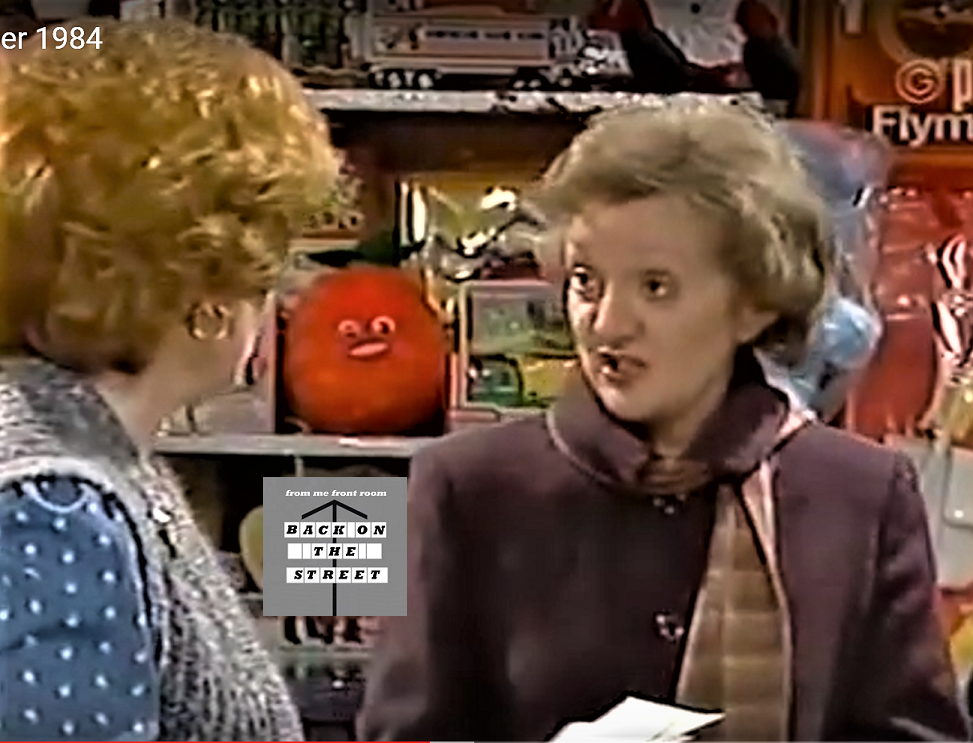
'I'm telling you now, Rita, that pineapple thingie's giving me the creeps! I can feel its eyes on me!'
'Get a grip, Mavis! There's a lot stranger things round 'ere...'

Next door, of course, baker Joe Dawson opened up a genteel little tea shop in 1978, causing the Kabin's café to close, and, in 1980, this genteel little emporium was bought by one Jim Sedgewick, who turned it into a rough and ready transport café.

In 1990, Rita sold the old Kabin and moved to a brand new one in Coronation Street. But Jim's Café continued to be featured. And here comes another mystery...

After a while, the old Kabin simply disappeared.

The doors to the Kabin and Jim's faced each other across a small, covered lobby.

The Kabin door remained for a while after Rita had decamped, seen from the interior of Jim's whenever somebody opened the door to enter or exit. But then, suddenly, without explanation, the old Kabin door disappeared, and was replaced by an advertising or community notice board. Jim's Café was suddenly at the end of a terrace of shops - and there was no sign of a covered lobby - or a shop next door where the old Kabin should have been - and no sign that part of the terrace had been demolished either.

Never mind, cock.

What a difference a decade makes! In 1984, it was Mavis, Rita and the pineapple thingie. In 1994, the old Kabin had vanished.

Next time I'll be takin' a look at the other side of the streets - Coronation and Archie - to delve more into't past and some of its oddities.

Anyway, I'm off to bingo and that new Pizza Hut in Esmerelda Street with Ida Clough tonight - so I'd better be makin' tracks. Should be a great night. You know worra laugh she is.


Part 5 is HERE

Thursday, 6 February 2020

1984-1985: The Fruity Thingie At The Kabin...

September 1984, and Mavis Riley and Derek Wilton are planning their wedding (that wasn't), unaware they are being upstaged.

We'll have quite a lot to say about the old Kabin in Rosamund Street in the next instalment of our What If Coronation Street Was Archie Street? series, but, in the meantime, can anybody solve a little mid-1980s mystery?

Times change of course, and some of us who were kids back in the old days can recall having toys which, although deemed 'cute' at the time, were actually a bit on the ugly side by modern day standards.

The Kabin, of course, sold (and sells) a few toys, and in late 1984 a strange little fruity thing (Orange? Pineapple?) flitted around the shelves for a few months, into early 1985.

The thingie with Rita Fairclough.

What on earth was it? A child's cuddly? Some kind of activity toy (in certain lights it seemed to have a handle on the side). WHAT? It was certainly a character, arresting my attention in many scenes, and seemingly quite a performer in its own right.

As Mavis tells Reet where to get off, Ken Barlow is getting the eye from the fruity thingie.

Did any readers own a toy like this? Has anybody spotted one in an old mail order catalogue from those days? If so, can we have the details, please? We're dead curious!

November 1984, and the fruity thingie is still on the shelf - a different shelf this time, having scuttled up on to the top one. Tony Cunliffe is blissfully oblivious that the thingie is leering down at him.

Tuesday, 4 February 2020

What If Coronation Street Was Archie Street? Part Three

So, having clattered up the Coronation Street and Archie Street terraces, we find ourselves at the side of the buildings. Next to us is Coronation Street's Viaduct Street. Of course, the viaduct looms. In the Archie Street universe we're on Taylorson Street, standing by the front door to the off-licence living accommodation. The Corrie Corner Shop has a side door, too. It provides access to the flat above the shop.

No viaduct ever loomed over Archie Street. It was a bit loomed over by St Clement's Church at the other end of the road from the off-licence, and certain perspectives allowed the Ordsall Board School (local education board, not boarding) to loom a bit too. Must have been pleasant for the local kiddies out playing. Nice reminder of the joys awaiting them.

The viaduct has seen a lot of changes, of course. I don't recall the days of the Viaduct Sporting Club, but it was once there, and of course a train came off it in 1967 and a tram years later, and Deirdre Langton was 'molested' there and Tommy Deakin and his donkey hung out there and two robbers, out to loot the corner shop off-licence, watched till the coast  was clear there and Ena Sharples and Lucille Hewitt sang a duet there... oooh, all sorts.

But it was definitely subject to change. In the early 1960s a low wall ran across the street, dividing it from the viaduct, and in 1968 the whole thing looked rather different - definitely seedier, and in 1982 the whole thing looked rather different again (and better kept). It also sprouted a high wall and a fancy tower behind it.

Eee, luv, didn't it all look lovely in't 1980s? Real upwardly mobile.

I had suspicions in the 1980s that the viaduct had been snipped at both ends. Several views from the backyards revealed the structure suddenly ended, distinctly unsafe for trains, and when the new development was built in 1989, the fact that the other end was similarly snipped became painfully evident. Fortunately, since then, CGI has come to the rescue, allowing the viaduct to deposit a tram in the corner shop.

1989: in the stress of being interviewed by the local pigs while he's on the job, Alan Bradley can be forgiven for not noticing the snipped viaduct.

Residents of Archie Street might have found their surroundings faintly potty if they'd lived in Coronation Street, but our old pals in Weatherfield carried on regardless.

Another snipped viaduct arch now straddles Rosamund Street, of course. It arrived out of nowhere sometime around the turn of the century, and is almost bolted onto the side of the Rovers Return. Now, it's no use fans arguing that Maggie Clegg mentioned it in 1972 or some-such and that it's always been there. Because it ain't. Numerous views along the side of the Rovers over the years have revealed the lack, as have officially sanctioned artists' representations of Weatherfield. Up until a few years ago, Rosamund Street was revealed, stretching away into the distance, through the arch. But suddenly that changed and Rosamund Street is no longer a long straight road running through the town, as it was for over fifty years.

Don't fight the weirdness, luvvies - embrace it.

Like the course of true love, the course of Rosamund Street doesn't run smooth. Like the course of true love, it's subject to sudden, inexplicable change.

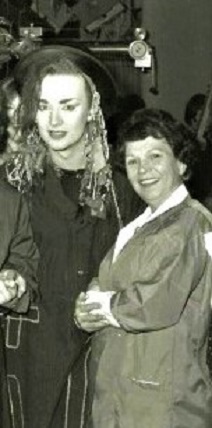
Well, luvs, time I were off. More coming soon, when we'll 'ave a poke round in the backyards. Boy George's opening the new extension at the Co-op today and Ida Clough's gone to get her picture took, so I'm right mithered. Mr Baldwin's been screaming blue murder.

Look at 'im - flaming disgrace!

Part 4 is HERE

Monday, 1 July 2019

What If Coronation Street Was Archie Street? Part 2

So, luvs, welcome to Part Two of our little series on the differences between Coronation Street and its long demolished template, Archie Street in the Ordsall district of Salford.

Well, we often noticed the lack of chimneys. In Corrie, not Archie Street. This was obvious in longer shots of the exterior sets after the first set was moved outside in 1968, then recreated in brick in 1969 (backyards were added later). Coronation Street had no chimneys. So, how did Suzie Birchall lob a brick down one in a late 1970s episode? Lord alone knows. We only saw it in close-up, and afterwards it was gone forever. Coal fires were possible in the house interiors though, so I suppose nobody noticed the lack of the necessary up-above.

"Chimneys? Nay, lass, we didn't 'ave chimeys round 'ere in them days. We never noticed the lack
either. We didn't even 'ave whole roofs. AND the cobbles ran the wrong way. We just carried on. We were built of sterner stuff. You young 'uns don't know yer born..."

This strange state of affairs lasted until 1982, when suddenly Corrie had chimneys. And the graffiti littering certain walls, and general run-down appearance of the place, suddenly disappeared. And the house exteriors suddenly got bigger, and there was a building on Rosamund Street we'd never seen before - which became a disco and wine bar. We supposed it was all due to the fact that the 1980s were an expansive and upwardly mobile decade.

Archie Street didn't get bigger. It got demolished. The first families were moved out in 1968 and demolition followed in 1971. But Coronation Street had survived. And was booming.

Even in the new scheme of things, the Corrie exterior was still too small to accommodate what was supposedly inside.

In't '80s, the Street suddenly got chimneys, fully-structured houses, and even the cobbles ran the right way!

Next, we pause at Number 13, home to our beloved Stan and Hilda Ogden. Here lies the strange tale of the straightened wall.

Now, Stan and Hilda didn't ever have much to boast about. They weren't even 'on the phone' (landline, of course - no cell phones back then). Actually, to go off on a tandem, sorry, I mean at a tangent, this made them far more natural back street denizens of that era than most other Corrie residents. It wasn't until the 1980s that 50% of UK households were on the phone, and Coronation Street always seemed a bit too populated with phone subscribers compared to real life humble back street dwellers like me. In my street of twenty houses, only one person had a phone by 1981. Yep, by not having a phone, the Ogdens were being more true to back street life, as I and my true life neighbours were living it, than Elsie Tanner!

But their house was a typically twilight zone Corrie dwelling in other respects.

However, from 1976 onwards, the Ogdens had one thing to boast about.

And I'm not talking about Stan's canteen-sized serving hatch.

Nope. I'm talking about Hilda's murals or 'muriels' (1976-1978 and 1978-1988).

And a wall which flattened itself to accommodate them.

The Oggies had a contoured or stepped wall which miraculously flattened itself when Eddie flogged them the first scenic delight. I think the 'muriel' would have been even funnier with the contoured wall, but there you go. The Oggies' house was obviously very obliging. At times.

'Ee, Stan, I'll 'ave to 'ave a polite word with that wall before Eddie puts me muriel up...'

'Naice' Wendy Nightingale - the first of two wanton Wendys in the life of Ken Barlow - was far too polite to notice the scaffolding, plank, and cold, grey sky in the Oggies' hall in 1976.

Clopping on down to the Corner Shop, we discover several mysteries.

The Corner Shop resembled its Archie Street counterpart (the Daniel Clifton off-licence branch) in exterior appearance more than any other Corrie property. Particularly when it became obvious the Corrie houses had adjoining bay windows (sometimes, early on). The adjoining bays moved the Street away from the template design.

Elsie Tanner and Ena Sharples go hell for leather outside Elsie and Christine Hardman's adjoining bay windows in 1961. By the time of  Ida Barlow's funeral later that year, the windows were having a trial separation. They'd done it before, too.

Mouse-like Florrie Lindley revealed an unexpected brave side when she had the shop frontage drastically altered in the mid-1960s. The shop door was moved from the Viaduct Street corner onto the street itself. This was fine. Logical. Once again, the shop was a little small on the outside to accommodate what was within, but it was when you looked upstairs at the shop flat that the real problems began.

The flat's interior had too many windows and sometimes had its own kitchen and sometimes didn't. Bet didn't seem to have a kitchen and slummed it with Renee and Alf when it came to meals. But the kitchen was very evident at other times - particularly when Kevin and Sally lived there. And the flat was pleasantly lighted - by several windows which didn't exist outside. Where WERE those windows on the exterior set, some of us wondered? In fact, we were surprised when a bathroom window was suddenly revealed in October 1980 to accommodate a story about Tracy Langton getting locked in the lavatory. Where had it been all our lives?

Intrepid Alf Roberts to the rescue - up a ladder to coax the door key from Tracy Langton who had discovered a toilet at the Corner Shop - and locked herself in.

"We've gotta get outta 'ere, luv," - Kevin and Sally Webster are freaked out by the sudden realisation that the Corner Shop flat has too many windows.

In the next exciting episode, we look at a few more mysteries of the terrace, the viaduct, Rosamund Street and the other side of the streets (Archie and Coronation).

Now, I'm off to't pork butcher's before they close. I like to give my family a proper cooked meal every night - none o' yer tinned rubbish. You can ask anybody. Ask Ida Clough.


Part 3 is HERE.

Sunday, 5 May 2019

What If Coronation Street Was Archie Street? Part 1

Well, luvs, had a long break and things are all right here. Well, Ida's bought herself a new pair of neon pink fluffy mules, but apart from that. Talk about mutton dressed up as lamb...

Anyway, I was thinking about Corrie and its origins the other night and the long-gone template for the terrace, Archie Street, in the Ordsall district of Salford.

Of course, the terrace selected was just a template, and while Corrie used the actual Archie Street in its opening titles for a while, things soon began to alter.

Let's take a look (wi' a dash of humour, luvvie, cos we could all do wi' some), at how Coronation Street began and its original differences from Archie Street, then look at how things evolved...

For a start, Archie Street had no corner pub. Nope. Not a single one. So, you'll just have to go to't Flyin' Horse, won't yer? Or nip down to the corner off-licence. No Corner Shop, but an off-licence, part of the Daniel Clifton chain. Not sure if Florrie Lindley would've fancied it, but then she used to work in a pub...

The Archie Street terrace also had more houses and single bay windows - which were represented in Coronation Street for a time. The trouble was, in erecting a studio frontage, space was at a premium, so the bays became joined in Corrie Land.

With no Rovers in Archie Street, we dispensed with some mysteries, of course. Like how the Rovers toilets led into Albert Tatlock's house (even the addition of a tiny entry on the 1982 set didn't really alleviate the embarrassment) - and why there was a huge Select with a stage which would have stretched right across Rosamund Street, the same being true for the back parlour and kitchen.

Eee 'eck, Mrs Walker!

"My dear! The things I have suffered!"

The great Rovers 1940s Show in the 1970s - with Norma Ford, Bet Lynch and Betty Turpin giving it their all in the mysterious Select. Look out, girls there's a bus coming!

At Mr Tatlock's, mysteries were fewer, though we did wonder - as we did with all the houses - why they were so much bigger on the inside than the out. The hall wall beside the front door was sometimes wider than at others (as with the rest of the houses) and Albert once sprouted a door at the top of his stairs which would have led directly into Emily Bishop's (REALLY, MR TATLOCK!), but never mind.

Unlike Archie Street, the houses in Coronation Street had hallways. In Archie Street, the front door opened directly into the front room. The stairs were accessible from the back room (kitchen with range) and ran up the middle of the house. Just how you got the stairs and hallway into the Corrie frontages was a bit of a mystery. But then the place was teeming with them.

Like that dreadful time the lorry crashed into the Rovers in 1979 and Emily's house temporarily grew a new wall which blocked off her stairs. Thank goodness there was an outside lavvy as well.

As soon as you turned your back, strange things happened in the Corrie houses.

But a day or two later things were back to normal. And nobody had noticed a darned thing!

Mind you, Emily's upper floor was obviously not a very hospitable place. Some writer once said there was no place colder than an English bedroom, and Emily and Ernest's was probably the very worst. When Minnie Caldwell's house went up for sale in 1976, we were treated to a view of the Bishops' bedroom window, curtains gently fluttering, and grey sky and scaffolding behind them. BRRR!!

Talking of upstairs, Corrie houses had incredibly high ceilings back in the 1960s, '70s and '80s. So high, you never saw them - just an expanse of wall above the picture rail. Very odd as that didn't match the exteriors at all, with the bedroom windows lying low over the bay windows...

Archie Street never had a house with a collapsing frontage. But Coronation Street did. Number 7 succumbed to that fate in 1965. Looking at the ruined frontage, it's odd that it seems to have widened at this point. And the houses either side have obviously made way for its expansion. The area was made safe and a bench was placed in the space. Very odd. That's all there was space for. As one letter-writer to a national newspaper wrote in 1981, when Len Fairclough was planning to build a new house there: 'The only people that could live there would be Marti Caine and the Thin Man!'

Look how far the front door is from the bay window!

Well, ducks, I'll be off now. That's it for the first part. There's another on't way. Just to say, all this is written with great affection as I loved Corrie back in its first three decades. And for all modern day fans - well mysteries like the sudden arch near the Rovers and the fact that Rosamund Street is no longer a long road running on a straight course through Weatherfield are nowt new.

Wonder what the residents of Archie Street would have said if their environs had been subject to the same Twilight Zone madness as Corrie's?

Part 2 is HERE.

Tuesday, 10 July 2018

Coronation Street - My Favourite Characters Of The 1960s, 1970s and 1980s... Number 20: Mr Swindley


'Oh, Mr Swindley! Is it going to go off?'

Here we go, chuck, I'm now going to bore you all rigid with my own personal countdown of the characters I think made Corrie shine especially bright in its first three decades. Together with a few glances at missed opportunities - minor characters I thought could have been built up into major ones!

This will be my own personal Top Twenty of my fave Street folk from way back then (one or two who are still around!) and I hope you enjoy it. I do me best here to make things entertaining. You can ask anybody. Ask Ida Clough.

Here we go then, Number 20 is... Leonard Swindley - played by Arthur Lowe in the early-to-mid 1960s.

Mr Swindley ran his Rosamund Street 'emporium' - a small haberdashery shop - with the devoted Miss Emily Nugent - who merged her baby linen business with his.

Mr Swindley was a lay preacher and held great sway at the Glad Tidings Mission Hall in Coronation Street, but not with its resident caretaker, Mrs Ena Sharples, who once described him as 'a puffed up little fish in a dirty little pond'!

She were lovely, our Mrs Sharples.

But, to be honest, Mr Swindley was, basically, a pompous windbag who meant well.

When his business was taken over by a chain called Gamma Garments, Mr S was immediately in awe of his new boss - Mr Papagopolous. This terrifying vision of 1960s capitalism was always kept off-screen (rather like Arthur Daley's 'Er Indoors' years later), but his telephone calls and threatened visits to his Rosamund Street branch were enough to send Mr Swindley - and, indeed, Miss Nugent - into a severe attack of the screaming 'abdabs.

Apart from Miss Nugent, Mr Swindley found his staff - namely Miss Doreen Lostock, of the Corner Shop flat in Coronation Street, a great disappointment. On one occasion, when Mr S called 'Forward one' to summon a member of his staff to assist with a customer, Miss Lostock actually asked: 'What number am I, then?'

Well, I ask you!

Poor old Leonard - jilted by his beloved Miss Nugent, terrorised by the sinisterly-unseen Mr Papagopolous, spun out of the Street and into a couple of spin-offs - and actor Arthur Lowe into even greater fame in Dad's Army.

Fab indeed.

'Whatever does that mean, Miss Nugent?'

'I've really no idea, Mr Swindley…'


Wednesday, 20 June 2018

Tom Mennard - The Secret Life Of Sam Tindall...

Phyllis (Jill Summers) and Sam (Tom Mennard). The great Percy Sugden Formation Dancers debacle of 1987.

Tom Mennard stepped into Coronation Street as Sam Tindall in 1985 - preparing for a local bowling tournament. He quickly became a suitor for that Weatherfield femme fatale Phyllis Pearce - but, sadly, she didn't really reckon 'im. He lacked the drive and persona of a certain Mr Sugden. Of course, our Phyllis weren't above using Sam to try and arouse a bit of jealousy in old Percy. Bowls? Formation dancing? She was that desperate she'd have tried anything. But it was all to no avail.

Never mind. Sam did try to sell his dog Dougal's services to Terry Duckworth and Curly Watts as a ratter in 1985, and in the same year he was happy to win Percy Sugden's Christmas pudding in a raffle - until Alf Roberts sat on it.

Phyllis's heart belonged to Percy - although he didn't want it.

Sam was a 'permanent occasional' character in Coronation Street from September 1985 to May 1989. He arrived unheralded as a customer at Jim's Café, and left the same way.

The triangle - Percy, Sam and Phyllis. Well, to be truthful, it wasn't that much of a triangle because old Perce couldn't stick Phyllis. But she lived in hope. Phyllis's hair looks particularly nice in this pic, we think. She was living proof that Punks didn't come up with the coloured hair theme. Pensioners had been doing it for donkey's years.

Sam was quite fun, and - sometimes carrying his dog Dougal in a bag - was a distinctive sight around the Street, although, like Phyllis, he never actually lived there.

I enjoyed Sam. Not the most fascinating of characters, but quite a gentle one, well played by the actor. Characters like that were an asset to the Street back then.

But I was already a huge fan of Tom Mennard before his Street debut and felt that his talents were rather underused on the show.

Picture it... the early 1980s... a scruffy young ratbag in a dreadful 'lad's cave' bedroom is twiddling his radio knob in despair. In those days, Radio 1 with John Peel in the evenings played 'music' that sounded like a tin bath falling down a flight of concrete steps. The scruffy young ratbag usually listened to Radio Luxemburg instead, but the reception was lousy and on this particular night he was desperately seeking something half decent he could actually hear when he happened upon the dulcet tones of Tom Mennard, talking about his mates at a pub called the Goat and Compasses and the dreadful affect fresh air could have on a body when it left a pub. You see, it wasn't alcohol at all...

I (AKA the scruffy young ratbag) listened - at first bemused and then amused.

I later discovered I  was listening to a series called Tom Mennard Tells Local Tales on BBC Radio 2. Radio 2?! Yuck, wouldn't usually give it house room, but I was going through a touch of the love life traumas at the time (don't get me started) and was in the mood to be soothed by a bit of comforting older generation daftness.

I liked what I heard.

Local Tales began in March 1981, and ran for a few years - ending sometime in the mid-to-late decade. Each tale only lasted about twelve minutes, but, although I preferred the blossoming alternative comedy scene, there was no denying Tom's ability to spin a good yarn and I was captivated.

The Radio Times synopsis for 12 March 1981 read:

Tom Mennard

Tells Local Tales

Welcome to Tom's world. The scene is the ' Goat and Compasses ', the cast - Tom, Harry , Charlie and Fred. The stories, well, they're just Local Tales. Order yourself a pint, sit down and listen. Written by TOM MENNARD Producer MIKE CRAIG BBC Manchester

The set-up was Tom doing a spot of stand-up, weaving tales of himself and his pals. There was nothing trendy or ground-breaking about it. Radio 2 was a station for fogies (it plays 1980s music these days and I listen to it regularly, so it obviously isn't for fogies anymore), but I'd always been partial to old fogey tales. Tom wrote it all himself and I think he was a bit of a genius.

Whether white-washing the local sewers or watching a male stripper on a coach outing to Blackpool, Tom, sounding like a rather more animated Sam Tindall, made me smile. Lots.

It was all beautifully droll and charmingly naïve. When hearing that the wife of a bloke in the local pub was having an affair, Tom assumed that the reason for the bloke's distress was because she'd got expensive caterers in.

Well, you would, wouldn't you?

Tom, born in Beeston, Leeds, had once been a bus driver in Brighton. He began writing scripts for local amateur village hall-style shows and in the mid-1950s began a career as an entertainer in music hall, radio and television. Through this, he first met Jill Summers and Bill Waddington - later, of course, his Street co-stars.

Tom became a seasoned stand-up comedian, appearing at venues such as the Windmill Theatre and on such telly shows as The Good Old Days with patter akin to the Local Tales. The idea of expanding the patter into a whole series of radio shows was inspired.

While The Good Old Days was shamelessly nostalgia-based, the Local Tales landed Tom and his pals squarely in the 1980s, with mentions of the Unions, unemployment and government cutbacks.

Tom had quite a lot to do with BBC radio in the 1980s. In 1980 and 1981 he starred in a Radio 4 series called Wrinkles - set in an old folks' home and written by Rob Grant and Doug Naylor - who gave us the sublime Red Dwarf on TV in 1988. I didn't hear Wrinkles at the time, but I have heard several episodes since. It's fab - probably a bit ahead of its time - with distinctly surreal touches. Tom starred as the caretaker at the home. It's highly recommended. Superlative in fact (you'll get the reference if you have a listen).

Tom also had acting roles in other TV shows apart from the Street - including Dad's Army, All Creatures Great and Small and Open All Hours.

Jim's Café, 1985. Sam and Phyllis talk hotpot.

Bowls were a serious business in 1980s Weatherfield.

Tom's own rare Lhasa Apso miniature dog, Dougal, played the Dougal of bag fame in the show. Tom also kept hamsters, tropical fish and caged birds, including zebra finches, a cockatiel, canaries and a wydah bird.

Dougal even had his own bank account and fan club. Lucky lad. I wonder if he had Mr Dog for dinner?

The character of Sam Tindall was simply designed as a component of the Phyllis/Percy scenario. He was a pawn in lovelorn Phyllis's game really - her desire to win Percy's affections was so great she'd stop at nothing. The occasional Street appearances suited Tom, who was then living in Dorset. But I think he could have brought a lot of fun to a larger role, particularly if the production team had revealed the Goat and Compasses to be Sam's usual local when not pursuing Phyllis - thus revealing a hidden and hilarious life for Sam. With a bit of tweaking, Tom's tales would have fitted beautifully into the Street setting.

Tom died in November 1989. Back On The Street remembers him fondly.


Thursday, 14 June 2018

The Mark Brittain Warehouse Fire Of October 1975 - An Anniversary Celebration? No. Just Examine The Newspaper Archives.

The end of the Mark Brittain Warehouse. The fire engines dwarfed the miniature terrace back then and the production team tried their best to disguise the fact. Edna Gee, wife of Fred-Face, worked at the Warehouse with Ivy Tilsley - whose husband was then called Jack.

Rebecca has written to us!

I've been surprised to read on the Coronation Street Wiki that the fire at the Mark Brittain warehouse in 1975, in which Edna Gee died, was intended as a celebration of the show's 15th anniversary. I didn't hear that at the time and soaps didn't usually celebrate with disasters back then. Is it true? And if so, why was it in early October, two months before the anniversary?

It wasn't true, Rebecca. We remember the Street's fifteenth anniversary very well and it was not linked to that. Indeed, as you say, it was two months in the past by then. After all, roasting somebody alive would not have pleased viewers as an anniversary celebration in those days. In fact, I think it would have seemed bizarre and grotesque. Nowadays, folks would adore it. The story seems to have to come from ex-archivist Daran Little, who was a little lad back then. He probably just made a throw-away comment and you know how today's netty types run with these things.

After all, if it was so - and disasters were really 'in' for anniversaries back then, think of the disasters they could have had for their 20th and 25th and 30th anniversaries.

You will find no publicity from 1975 verifying the claim - just examine the newspaper archives (it was pointed out, however, that the Street was low in the ratings and could 'do with some kind of boost'), and the more than two month gap makes the claim an absurdity. Soaps didn't 'celebrate' with disasters back then.
'Liverpool Echo', 1 October, 1975.

Having said that, we've a lot of time for Daran Little. Even if he does make the odd cock-up. His East Street thingie with Gail making her mark on the EastEnders café is a true delight. For that reason alone, we'd walk over hot coals for the lad. Probably.